reabc/Martin Sostre in Court/Martin Sostre in Court.pdf
Web PDF • Imposed PDF• Raw TXT (OCR)




![lo 19 FEBRUARY 1968 THE USE OF PSYCHIATRY AS AN INSTRUMENT OF REPRESSION With this hearing, called by the Court t0 set the stage Jfor a much more momentous event, the reader is introduced to the two main figures who will dominate all that follows. On the one hand, Martin Sostre, thrust by his bravery and wisdom 1o the very forefront of the struggle against his people’s oppressor. On the other hand, Judge Frederick M. Marshall, a man whose own words condemn him: “[1 am] sick and tired of the long hairs, beatniks, the ultraliberas, the unwashed, the exhibitionists. And despise their marching, their singing, their bleating, rabble-sousing, placard-carrying and card burning.” And it may be seen that this pamphlet i not only about two men. It s also a part of the much lager story of two historic classes and two nations. The one, looted and decimated for generations, the other powerful, armogant and morally bankrupt are here locked in combat. Viewed in this way, the story you are about to read i part of the global struggle now unfolding against U.S. imperialism. Martin’s technique in this hearing was to question at length the psychiatrists who were responsible for fabricating the report ‘on Martin’s mental state. At the very start he questioned a reference to his race on the first page of the psychiatic report. He asked the doctor (one of the psychiatrists who had written up the report) what bearing race had on his evaluation. The doctor replied that, I took into consideration that you were a Negro in rlation to a multiplcity of other events that reiated to your background as you explained it.” Martin was not very satisfied with this obscurantist answer. He asked whether the doctor had taken into account the real condition of the black people s an oppressed minority living in a white racist, hostile environment. At this point the asistant D.A. jumped up and objected that this was irelevant (ss he did some twenty o thirty more](Martin Sostre in Court 10.png)




![20 Mr. Mintz: Your Honor, pursuant to your instructions, th resources of the Erie County Bar Association Aid to Indigent Prisoners Socity were ‘made available to the defendant and Mr. Maloney and for the purposes of investigating and securing_ or attemping 10 secure witnesses or statements fiom witnesses on behalf of the defendant. Donald Dade, of the Legal Aid Bureau, made an investigation and I expect him to be in the courtroom this momin. I cannot sate first-hand what the results of that investgation were. I did talk with Mr. Blumbers. Harold Blumbers, the defendant’s fist-retained attorney, in an effor to secure the names and addresses of witnesses and he indicated to me that they had 10 names or addresses. He is not present in the courtroom but I am sure he could be avalable, if necessary. I don’t know if the Court is intersted in anything further with reference to_investigation. I do know that Mr. Dade indicated also that he did make contact with and Jad an_interview with one of the two posible witnesses for the defendant, a Charls Howard and Darrel Groves. Marshall: He mentioned those o the Court the other day. Have you spoken with the defendant? Mintz: No, I have not. { intended to when I was originally assgned and e chose not to talk with me. Marshall: Mr. Maloney, can you tell us anything new other than what ou told us the other day? Mr. Maloney: The only addiional thing is tha I spoke with My Mintz and Mr. Dade, and one of the witnesses that I had seen the night before was here afte the Court adjourned and Mr. Dade proceeded to take his statement. ] haven’t seen M. Dade since, | have also talked with the defendant and he said that he is not interested in those witnesses and they are not his witnesses and that i that. | mean, that was Hisattitude on the whole thing. Soste: I regads (o these witnesses, Mr. Dade at about six-thirty ast night was at the jail and this was the first time 1 had seen him with regard 1o the witnesses. I gave him the same detailed description of these four witnesses, not the ones that the Cour, that s the two witnesses.that the Court is trying 1o obtain. These are the Court witnesse, 1 imagine, this Darrel Marshll: am not rying to obtain those two witnesses. Go ahead. Sostre: [ have never subpoenaed any witnesses, but the Court has employed a means outside of the scope of the Code of Criminal Procedure to obtain witnesses which I have ot requested and the Court ‘has made much to do about appointing investigators and siatemens, | believe were taken from these witnesses, a copy of which I have here. One of them, by the name of Darel Groves, who incidentally i under](Martin Sostre in Court 20.png)


![=7 entered. He further siid that they were also phonograph record customers. According to Defendant, Charles Howard received a brutal beating from the police causing severe swelling of Howard’s arm. Defendant states that the police wanted to coerce Howard 10 confess that he, Defendant, had been manufucturing Molotov cockiails, Defendant stated that he did not want these three persons as witnesses for the defense. He said that he wants the four witnesses that I have already mentioned. An investigation which included a thorough search of the business places, residences, and strets in the surounding area of Jefferson, Glenwood, Woodlawn and Dupont Aveues in an effort to locate Defendant’s four witnesses - Defendant desired and requested that this be done - for a period commencing at 9:30 p.m. - I might indicate here, Your Honor, I haven’t written it in, but Mr. Sostre indicated that this could best be done by him if he were out on bail. Fora period commencing at 9:30 p.m. on 3/6/67 to 3:30 a.m., 3/7/68- 1 am sorry, 3/6]68 0 3:30 a.m. on 3/7/68, approximately two hundred persons were -interviewed at taverns, poolrooms, residences, service stations, restaurants, liquor stores and the streets in the area indicated above. No one interviewed or questioned relative o the four witnesses of the defendant knew of anyone either fitting the descriptions of the witnesses indicated nor did they indicate seeing anyone in the area around the date of the raid on the Defendant’s store. Defendant stated during. the interview that only he could round up these witnesses. Darrel Grove’s statement Defendant gave no names nor addresses and no other information relating to the witnesses. The descriptions given by the defendant of his witnesses from the interviews that I have had could fit any number of persons frequenting the general area where the Defendant’s store is situated, Prior to_the interview with Mr. Sostre, I did interview d Mr. Darrel Groves who gave a statement relative 1o the events on the evening of July 14th, 1967. The statement is as follows: “Darrel Groves, being duly sworn, deposes and says that he is nineteen years of age. Date of birth, October 16th, 1949. Residing at ... Statement taken at Erie County Hall, Part 1, Erie County Court, by Dorald Dade, Investigator, Legal Aid Bureau. I do not know Martin Sostre but 1 know Martin Sostre from my presence in his bookstore located on Jefferson Avenue near Woodlawn in the City of Buffalo, New York. I was in this store on July 14th, 1967, at about 10:30 to 11:00 p.m. I went o the store to purchase phonograph record. Mr. Sostre was conducting a fire sale on records. I noticed a young boy who](Martin Sostre in Court 24.png)
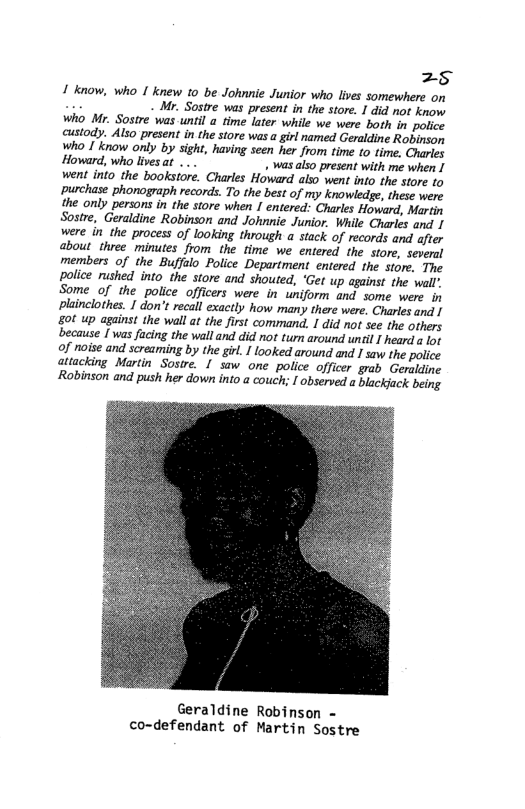
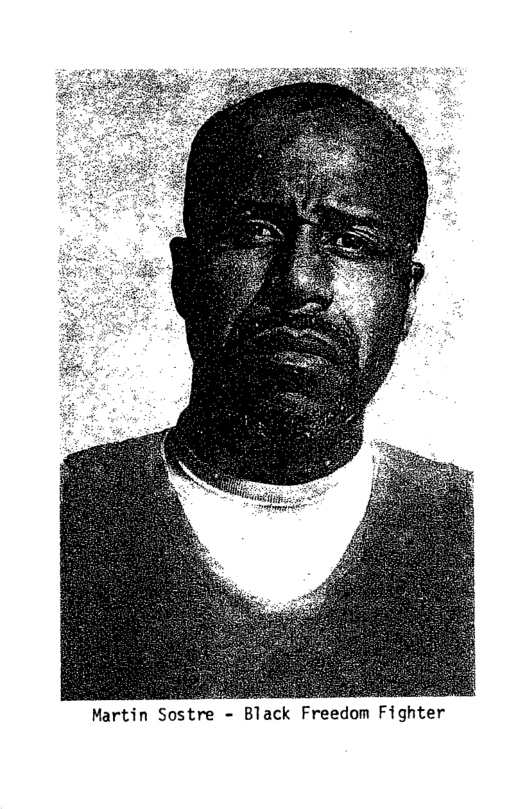
![Knowledge that drugs of any kind was ever sold in Martin Sostre’s bookstore, or by Martin Sostre. 1 have freely and voluntarily made the Joregoing statement without threat of any Kind and without promise or reward of anything. No force or threat of force was used to elici this statement from me. 1 have read and understand the statement and I find it 10 be true in every respect.” And signed, “Darrel Groves.” I conducted an investigation into the criminal record of Darrel Groves and have a certfied copy from the Police Department that he has no record outside of the case now pending against him in the City Court, and this is as far, Your Honor, as I have gotten in the two days that [ ‘have been assigned to do thisinvestigation. 27 Sostre’s rights denied, Notaro’s affirmed Marshall: Thank you. All right, Mr. Sostre, do you have any other witnesses other than these four that you claim? Sostre: No. All I have are the four witnesses that ] have been asking for and asking for reasonable bl to find them. Marshall: Do you desie to call any other witnesses? Sostre: 1do ot have any witnesses a this time. Marshall: Do you desire t0 take the stand? Sostee: At this time my attitude is the same. I am objecting 1o the whole frame-up deal and I canno participate in this, because I am being. denied opportunity 1o present a defense by being deliberately held under bail higher than anybody else’s for the purpose of covering this frame-up. This is what the Court uncovered accidentally just now. So you know why I can’t be allowed out there. Martin is then asked if he wishes to take the stand himself or to sum up. He repeas his refusal o participate in the staged farce and the Judge threatens him with contempt of court. Martin replies, “Your Honor, not only have I invoked my constitutional right to fair trial, and the constitutional right to be afforded the compulsory process of obtaining witnesses, the right of reasonable bail, the right to a fair trial, but | am also invoking the right to selfdefense in order to defend ‘myself from being lynched.” Marshall attempts t0 interrupt but Martin continues, “I have letters here that tate they took five hundred dollars from us and withdrew from the case after doing two hours’ work. So if the firm of Lipsitz and Fahringer can do that, I cannot put my freedom in the hands of anybody else.” Marshall then declares that Martin has waived his right to summation. He orders the jury retumed and then signals Notaro to begin his summation.](Martin Sostre in Court 27.png)



![26 power. That is fascism!” As the independent-thinking juror was leaving Martin said, “There’s 2 good man. He thinks for himself. But under the police. state you can’t think for yourself. Under fascism it’s not allowed.” Then Marshall asked Martin if he had any objection to the remaining jurors. Martin answered, “I object to these illegal ‘proceedings. This jury, in addition to being all-white, has had everyone with independent thinking taken out. Even the one who originally said he wouldn’t go along, because of the mass coercion and the coercive pressure of the rest of the jurors, was forced o change. Martin was referring here 10 one juror who changed his mind about “the law” when reexamined by Burke]. The only man with the guts to stick it out against the pressure was taken out.” ‘The Court called for a new juror to replace the one who had been semoved. After he was seated, Martin was given the opportunity t0 question_ him. Martin asked, “Sir, suppose your lfe were at stake because a law you were following blindly placed your life in jeopardy. ‘Would you continue to follow this law blindly or would you use your own thinking?” The juror said he would * ... follow the law.” Martin then said, as he tumed to the audience, “Watch this closely! This really shows what we’are up against, the seriousness of the massive coercion utilized against us.” Martin then stated that he wished to make further challenges and proceeded to ask a juror, “Do any black people live on your block?” ‘The juror replied in the negative. “How do you feel about the racial strife?” The juror said, “Don’t know.” Martin asked if he had read anything about Feliceita’s or Amico’s statements about who was responsible for the “riots?” The jurors said, almost niformly, 1 don’t secall.” Martin asked jurors if they recalled hearing of man named Martin Sostre who was supposed 1o_be-responsible for starting the webellion? He asked if they read the newspapers regularly, if’they recalled a police raid on the Afro-Asian Bookshop after the “riots.” Many jurors admitted reading articles about the rebellion and some, rather reluctantly, admitted_hearing about the Afro-Asian Bookshop and the police raid. Many of the jurors were extremely evasive and, of course, Marshall only encouraged this. One juror denied being in town during the rebellion but, when Martin pinned him down about dates, admitted having been in town and having read the slanderous newspaper artcles. Martin then began to ask questions almost exclusively about race and discrimination. He asked individual jurors if they had lived near any “colored” people, did they live in integrated neighborhoods, did they](Martin Sostre in Court 34.png)
![Juror: One works for us. Sostre: Where does he live? 3% Juror: In an integrated neighborhood. Sostre: Have you been ther? Juror: No. Sostre: Do you have any objection to black people lving in your neighborhood? Juror: Not f they are lawabiding. Sostre: Do you believe Negroes should receive ther civil rights? Juror: Yes, when they prove themselves capable of working. Sostre: What do you mean? You believe they haven’t proved themselves - the black people built this country! Jutor: Those that have proved themselves capable of working have what they want. Sostre: Do you believe that there is white racism in this country? Burke: Objection! Assistant D.A. Butke: Objection! Marshall: Sustained. You will be stopped when I consider questions improper. Sostre: Have you had any other personal relationships with Negroes, other than that one? Juror: No. Sostre: You don’t socialize with any other black people? Juror: No, just that one. Sostre: /turning to another juror, a businessman] Where do you live? Juror: Willamsville. [one of Buffalo’s poshest suburbs]. Sostre: Are there any black people in your neighborhood? Juror: Yes, yes! Ermie Warlick. [wellknown sports announcer, businessman and former football player]. Sostre: Any others? Juror: Two more. The neighborhood i predominately white. Sostre: Do you have any other relationships with black people?](Martin Sostre in Court 36.png)
![Marshal: Sustained! Sostee: You stated that you work in an allwhite office with one Hundred persons. Is it ‘the policy of this company to exclude Afro-Americans? Y2 Buske: Objection! Marshall: Sustained! Sostre: But this & a very important issue! Marshal: It i insignificant to me. Sostre: At least make a little show, Your Honor! Everyone knows it’sa Jrame-up but you ought, at least, to make alittle show of conducting a trial, [tuming to juror] In your determination of the issues of this case you said you would go along strictly with the law instead of using your own_conscience. You would go strictly by law regardless of conscience? Marshall: That’s his duty and his obligation! Sostre: That’s where we differ, Judge, because a person’s conscience and morality transcends the law. {tuming again to.the juror] You Would go along with the Judge and what he told you? Suppose the Judge is a racist judge? Marshall: You can’task that question! Sostre: You are o touchy about your racism that you are jumping the gun. No wonder the black commurity is angry at you as well as the entire enlightened segment of the white community. You can’t use indictments to intimidate us any longer. We are bringing resistance into the courtroom. You are finished with your fuscist tactics. We are opposing you. We have to b this i order to bring out all your racism. We have 10 oppose all these racists or otherwise they will continue to oppress us. Now we are preventing them from hiding behind judicial robes, playing the role of the benign judge. Martin resumed his examination of the jurors and their deep-rooted racism but each time his questions began to evoke their inevitable seaction Marshall would block it. After one such interruption, when Marshall told Sostre to_cither ask different sorts of questions or sit down, Martin retorted, *“Your Honor, you are the one who wans to continve with this farce. You would like me to sit down and stop asking the embarrassing questions which get at the racism and fascism here, Why don’t you gag me again like you are trying to gg the antiawar militants, the other dissenters? Marshall felt the need for a recess at this point and signalled the](Martin Sostre in Court 38.png)

![47 things I may be able 0 testify to, that do not appear in the minutes of your plea and the minutes of your sentence. On the other hand, I only read them hurriedly t0 refresh my recollection. Sostre: But you did read them? Blatt: Yes, and I remember this case personally. This is one of the cases Iremember personally. Martin persues the elementary point that Blatt’s memory is really itelevant since he has the documents. Blatt stubbornly defies simple Togic as Martin asks: Sostre: Mr. Blatt, regardless as to what reason you read them for, you read these minutes, o therefore you would know what is in them, whether you had remembered or not,is that correct? Blatt: That i not s0. No, thatis ot correc. Sostee: Now, you read the minutes, you familiarized yourself with the contents of the minutes. Did you see any other documents or photographs that would also refresh your memory @ to my identification? Blatt: The only thing I looked up were the papers in the fie. Sostre: Did they include a photograph? Blatt: No, they did not. Sostre: Js it usual for a defendant - is it usual for a defendant to be photographed at the time of his arrest? Blatt: That would be with the police department. I didn’t think it was Jair o you, 10 look at a photograph of you before I came to identify you. Sostre: But the District Attorney has access to the police photos, does he not? Blatt: That is his business. [ wouldn’t look at any photograph. I came up to identify you. Sostre: / said, the Distrct Attoney has access to the photograph? Blatt: That isright. Sostre: And had you wanted 10, you could have had the photograph of Martin Sostre? Blatt: Yes, ] could have gotten a photograph of Martin Sostre, yes. Sostee: And also, you could have gotten firgerprints, i that correct? Blatt: Yes](Martin Sostre in Court 43.png)



![$3 times” they brought prisoners “from upstairs down.” Martin persisted. “What was it in all the thousands, what distnguishing feature in this face stands out among all those thousands?” The witness decided that it must be Martin’s receding forehead. Martin found this assertion a litde more unbelievable, “But this is quite a common feature. In fact, right here in this courtroom we have a balding jury, judge and stenographer.” Brzyeyl then explained that the thape of Martin’s balding head was what was so distinctive. “What shape?” Martin demanded. “We understand that no two foreheads are identical.” Brzyeyl said that it was the “roundish” character which made the balding forehead so distinctive. Martin retorted, “Roundish! Would other heads be square? All heads are roundish.” Faced with this elementary observation, the witness soon became totally unresponsive. Martin tumed from the “witness” and demanded of Judge Marshall that the documents be thrown out as totally worthless. Marshall, as before, refused. ‘The next witness was assistant D.A. Peter Notaro who testified that he had been the prosecutor during the earler trial. He was present on March 7th when the verdict found Sostre “guilty 2s charged.” Martin asked Notaro if he worked out of the same offics as Burke, whether or ot they both had occasion to prosecute the same case, and handle the same files? Notaro nodded that this was true, The last witness called by Burke was the assistant Chief LD. Officer in the Buffalo_Police Department. Martin objected to the introduction of a set of prints taken in Buffalo and in Attica that Burke offered the Court. During questioning, the officer stated that it was true that he had no way of estimating the age of a given set of prints. It was impossible, from the print itslf, to tel when it had been obtained. “In other words,” Martin reasoned, “These prints [supposedly from Attica and Buffalo] could just as well have been taken simultancousy. As to how far apart they are in time, you would not be able to testify. Any date could be put on this card.” “That s posible.” the officer admitted. Martin moves for dismissal Martin moved 1o have the documents throwh out. Marshall immediately overruled him. “The People” then rested its case. The jury was excused by Marshall who then said, “We are going to hear any ‘motion the defendant may have.” Martin began his motion to dismiss for failure of proof. The prosecution had not proved its case. He also](Martin Sostre in Court 49.png)
![59 Buffalo Evening News, June 21, 1968 Felicetta Links Red Group To Disorders in Buffalo By ROLAND POWELL Buttaio Evening News Bures WASHINGTON, June 21 — Persons linked o a Com. munist splinter group were active in encouraging last June’s racial disturbance in Buffalo, Police Commis. sioner Frank N. Felicetta testified Thursday betore the House Committee on Un-American Activities, M. Felicetta said that Buffalo] ———————— Debice Photographed a number Black Muslims and other black wrihrsens handing out literwture nationalit groups wepe cetie ok hich, he said encouraged_ the|encouraging the riotng. e i Coting, and later pickoting Erie labeled Martin ~Sosies "y "¢ County Jai, where alleged icader of the predimirionc: Thoy "acr being held. He said|agitation, including insimeee they were identified as being|yauths in the use of il fonnected with an organization cockiails, Sostre. recenty oy Yo as Bullalo Youth Againstconvicted on marcoqes churmrs War & Fascism (YAWF). Mr. Felicetta said tha tlyars Chester D. Smith, "goneralldistributed. by m e m b1y of gounsel of the commitiee, placed| YAWF “told" the Nogrocs thor in_the record a statement by|life held no fature Sor shen: FBI Director J. Edgar Hoover|except poverty and serviee iy that YAWF is a youth group of | Vietnam.» Cmavorkers World Party, 3 “These lealets charged that Sommunist “splinter” organiza- Buttalo city offciats s pem son. were involved in an orgamized Mr. Felicetta also told the|repression of Negroes ja. f committee that members of the| fly-:’ the commissioner eon- inved.](Martin Sostre in Court 50.png)





TIN
SOSTRE
in Court
edited by Bob McCubbin
issued by the
MARTIN SOSTRE DEFENSE COMMITTEE
July 1969
Martin Sostre, Prison Revolutionary
By Lorenzo Komboa Ervin
Even in this generation, many young activsts know of George Jackson
aka “Comrade George,” Black Panther leader, revolutionary prison writer and
organizer who was assassinated in August, 1971, in the California
penitentiary, San Quer
Yet,in the late 1960s and early 1970's, Martin Sostre (1923-2015) was
every bit as well known as a prison activist, revolutionary, and jailhouse
lawyer, who almost single-handedly won democratic rightsfor prisoners to
eceive and read revolutionary iterature, write books, worship altemative:
religious faths, to not be held indefinitely i solitary confinement, and
to obtain legal rights to have access to legal rights at disciplinary
proceedings. He was the one responsible for prisoners being able to
organize during the prison struggle 1967-1974, These lawsuits changed
prison conditions nationwide.
He had served a sentence in Atica, New York, during the early 1960's
and went through a poltcal metamorphosis from a Black Muslim (NOD.
Black natonalis, and later an Anarchit In 1966, he got out of prison,
came home to Buffalo, N.Y. and started the Afro-Asian Bookstore in the
Black community. Sostre’s bookstore became center of radical thought and
poliica education in that city. A Black “iot” against police brutalty
of 2 Black youth broke out a this time, and Sostre was blamed for this
rebellon since many youth visited his bookstore.
The city cops and white political establishment chafed at Sostre's
organizing and political education, and decided to shut him down. They
amested him on July 14, 1967, along with a bookstore co-worker, and
charged them with “sale of narcotics iot, arson, and assault” These were
totaly frame-up charges, but he was sentenced to 41 years in prison.
Recognizing this injustice, an international campaign was begun on his
behalf by his supporters and fellow actvists.
At one point, he became the best known political prisoner in the world,
and his case becare adopted by Amnesty Intemational, the prisoner of
conscience organization in 1973 This was a fist for US. politica
prisoners and put tremendous pressure on the state of New York and the US.
‘goverment.Finaly his worldwide defense organization pressured the New
York state governor to grant Sostre an executive clemency, and he was
released in 1976,
Historical Importance of Martin Sostre y
Sostre’s politcal consciousness and legal activism opened the door for
prisoners to have legal and human rights and the ability to organize at @
time of civilrights, Black Power, the New Left, and the Vietnam anti-war
movements. At ohe stage, 1970-1976, the prison movement became the central
protest movement in America, especially after the August politcal
assassination of George Jackson, and the September, 1971 Attca rebellion,
The protest a Attica was put down with a bloody massacre by prison and
poliical offcals, but it opened the eyes of milions all over the world
to American sate violence and racism. A mass prison support movement arose
almost ovemight, which demanded human rights for prisoners. There is no
doubt that the prior demands of Martin Sostre, i his writings and
prisoner’ rights awsuits, who had been imprisoned at Atica some years
previous, played a role ideologically. Sostre's strugle inside as
politcal prisoner was clearly bound.up with what became the Attica
Rebelion.
Contrary to prison offcials’ accounts which now claim that the
so-alled Atica prison “riot” had taken place because of a “gang of
criminals* who took guards hostage for no good reason, the truth is New
York State offcals refused to listen to Sostre or even the federal courts
‘which over the years had ordered an end to brutality, racism, and
mistreatment of the men inside. The prisoners took matters into their own
hands, demanding human rights and an end to racist abuse with the 1971
rebelion, which shook America and the entire world.
Martin Sostre and Me
met Martn Sostre at the Federal Detention Center in New York City in
August/September, 1969. I had just been brought back to the USA from
Berin, Germany, for hijacking a plane to Cuba earfer that year. He had
sued prison offcials and been transferred to federal prison to await a.
hearing. I did't know who he was at the time, but someone said he was an
“actvist prisoner” and that I should talk to hir.
A scowling, powerfully built Black man, he looked like a teacher, which
in many ways he was, just a revolutionary teacher. So, | went up and
introduced myself, and we started talking about prison generally, but he
was interested in my case and how the CIA had captured me, and we started
{alking about that. He was concerned that I ould be sentenced to death by
an alk-white Southern jury.
Heknew it was a political case, and so we talked about what | could do
about t. Almost every day that I saw him, we would go over my case, and he
‘would give me legal advice. Somewhere along the line, we started talking
‘about revolutionary politcs generally, and he bounced a new word on me:
“Anarchist Socialism. I had no idea what he was talking about at the time.
Ihad just come from Cuba, Czechoslovakia, and East Germany, which called
themselves "socialist republics 5o | thought L knew all about it Iwas
wrong. He explained to me about “self-governing socialism.” which he
described as free of state bureaucracy, any kind of party or leader
dictatorship. Almost every day he regaled me about “direct democracy,
“communitarianism,” “radical autonomy,”“general assemblies,” and other
stuff 1 knew nothing about. 5o just fistened for hours as he schooled me.
The intialideas for Black autonomy, within the overall Anarchist
movement, came from these sessions. As a Black Puerto Rican, Sostre felt
alienated from his community, and since much of the analysis about Black
oppression and Socialism was by white radicals,he had originally
gravitated into Black nationalism. It was only later during his time in
prison that he gravitated into Anarchist Socialism. He told me endlessly
that Sociaism and Anarchism were for all people, not just Europeans and
well-to-do intellectuals. It was universal. At first, had serious doubts
about althi, as it seemed just more white radical student ideology. They
were not sympatheic to the Black struggle, and they were not working class
or poor. Sostre's ideas, however, were that Anarchists of color must build
their “wing" of the Anarchist movement. He didn't call it Black Autonomy,
but that is what it was.
1 did not even consider myself at the time as an Anarchist, and did not
fully understand what he told me. But | had seen fist-hand “Soviet
Socialism” and was not impressed. It was eliit, authoritarian, and
oppressive. | could say the same thing about "Manist-Leninist Maois
which helped to destroy the the 1960's New Left, and the radical wing of
the Black Power Movement, with cult of personality, midde class snobbery,
‘maripulation, and opporturism.
Even before meeting Martin Sostre, | was definitely already looking for
something new, and willing to consider Anarchism. But only years later,
serving lfe in prison,is when I really started into Anarchist politcal
education, as Sostre suggested. I started reading Anarchist books and
papers, and started corresponding with Anarchist figures and groups all
over the world.
These discussions with Martin Sostre were invaluable in broadening my
thinking about a radical politcal aternative. also found out about many
“unknown revolutions" in Africa, Russia, China, Spain and other parts of
the world, as well as early Anarchist labor/radical tendencies among
Easten European immigrants, especially in the USA (1860's-19005). et
the stickler i that the Anarchist movement generally, had no ties or
solidarity to the Black population in the USA, the UK, or the colonized
eople of color in the Third World. It was essentialy a white European
movement.
Like Sostre had said, we must manufacture our own Anarchist of Color
school of thought and revolutionary practice. Nobody can truly speak for us
and fight n our name. Black Autonomy means independence of thought, culture
2nd action. We are not racialseparatists, but we must be sure that we are
irang enough to nsist on our poliics, leadership, and respect within any
broader universal movement. We have been sold out left out, betrayed, and
tricked too many times by intenal racism inside majority white coalitions
and movements. Black voices matterl That is why I wrote a small pamphlet in
1972, “Anarchism and the Black Revolution" while 1 was in prison 1 197
Conclusion
Martin Sostre has been lost to history because the White Left and
Anarchist radical tendencies have had no regard for him or is legacy. He
fierally opened the doors fot radical prisoners, Anarchist tendencies of
color and radical praxi, yet not one institution or movement today fs
named after him. This is an outrage which must be recognized or corrected
now.
‘Groups of jalhouse lawyers should name themselves after the man who
more than anyone, successfull fought for prisoners’ democratic rights, was
an activist who provided an example of a revolutionary polifcal prisoner.
and who prefigured the Black-led revolutonary prison movement,inclucing
the Attica rebellion and prison labor and activist movements of the
197080
Ibecame an Anarchist, a jailhouse lawyer, and a prison actvist
during the 1970's because of Martin Sostre. I fact, it was a result of
obsenving Martins international defense committee and seeing how he was
able to put pressure on the govemment, that encouraged me to create the.
Free Lorenzo® movement, which resulted in my own freedom in 1984 from two
fife sentences. | owe hirm a tremendous personal debt. spoke to him less
than amonth n a prison cell, but it changed my ife. He had a similar
impact on many others who never met hirm, but benefted from him standing
up for their rghs.
‘We don't have him here today in the flesh, but we can at least honor his
memory and never et t die!
INTRODUCTION 7
Martin Gonzales Sostre was born in Harlem N.Y. on March 20,
1923. The years between this date and his long prison term from 1952
10 1964 were not unlike the early years of Malcolm X, Eldridge Cleaver
and millions of other oppressed youth of the black colony within
America. Survival and temporary escape have been the key words for
how many millions of the world’s poor under the conditions of abject
poverty imposed on them?
‘While in Attica State Prison, Martin, along with many other black
prisoners, became aware of a bold new force at work in the grassoots
of American society. lis first_ manifestations were in the Muslim
newspapers smuggled into the prison, in the whispered suggestions of a
Black Brotherhood and the strange but surprisingly sensible attacks on
the decadent white society outside the prison wall. Martin was able to
fit these ideas together with those he had picked up in Harlem as a
youth. He was able to see the power of these ideas and the way they
united the vast majority of mankind against the infinitesimal few who
rule
On his release from prison he came to Buffalo, a mere 35 miles
away, and got job as a steelworker. Once on the streets, Martin saw
that the youth were ready for action 10 test and refine the new ideas.
And Martin himself listened with growing excitement to the reports of
world-wide struggles, ever expanding, of the oppressed sgainst the
oppressors: Vietaam, the Arab world, Latin America, China, Africa,
Cuba. Everywhere, in the middle years of this decade, the poor were
sising up.
So Martin, on his carnings as a steelworker, rented a storefront in
the heart of the black community of Buffalo and stocked it, s best he
could, with writings on this global revolt of the poor against the rich.
He called his store the Afro-Asian Bookshop.
To the rich of Buffalo, the store did not go unnoticed. The visits
by local and federal cops began almost immediately. After the Buffalo
tebellion at the end of June in 1967 the harassment was stepped up.
Martin had not been idle during the rebellion. The salc of iterature had
increased greatly under the influence of “events”. To those who could
not pay, he lent it and sometimes gave it away. He kept the store open
all night and spoke to crowds, using pictures from magazines and the
white_cops, running hog-wild in the streets outside, o illustrate his
points about white colonialism and the need for black
self-determination and socialism.
Several days after the rebellion subsided, as an answer o his
'S
activties, the cops smashed the front windows of the store and firemen
hosed down the inside of the store, destroying most of the offending
literature. When Martin turned this attack to his advantage by plastering
political wall posters on the boarded-up windows, the cops tried to rip
them down. The long black Cadillacs o city officials passed, slowing to
a crawl as they passed the store. Martin informed several friends that
the store was under surveillance from a window across the sreet.
The final attack came on the evening of July 14th. Several
carloads of non-uniformed white cops stormed the shop, arrested
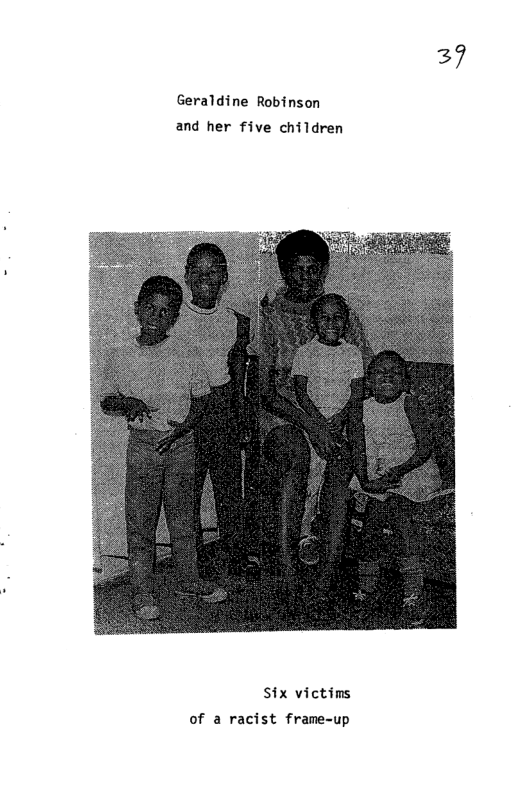
Geraldine Robinson, Martin Sostre and three young men in the store at
the time.
“The subsequent legal struggles, setbacks and gains,are described at
length in an earlier pamphiet, Letters From Prison, and cannot be
repeated here. For a copy of Letters, send $1.00 plus $.25 mailing cost
to the Martin Sostre Defense Committee.
The present work concerns the court appearances surrounding
Martin Sostre’s conviction on the frame-up charges of sl and
‘possession of heroin. The testimony has been reproduced from court
records and extensive notes taken by Defense Committee members.
There are three main parts to the story. First is the so<alled
“paychiatric hearing” which i preliminary to the main trial but
provides an introduction to the drama yet to unfold.
“The second part concerns the main trial itself. It might be expected
that this trial would be the central event since a determination of
Sostre’s innocence or guilt was to be made here. However, it cannot be
Stressed too strongly, particularly for the reader with no previous
scquaintance with the case, that the guilty verdict was a foregone
conclusion. Therefore, the important thing here was not the testimony
but rather Martin's periodic comments to the courtroom spectators
during lulls in the trial action. Martin chose not to participate in the
tial since the cards were so stacked against him a to render the
proceedings a complete travesty of justice. Among other things, he was
without counsel, having been flecced and double-crossed by those
retained for his defense.
‘The third part of what follows concerns the “second trial” or trial
to establish identity. In order to convict Sostre as a second offender,
thereby doubling the possible sentence from 20 to 40 years, it was
necessary to make a determination that this was the same Martin Sostre
who had been convicted in 1952 Martin chose to remain mute
regarding this determination 50 a trial was necessary. At no time does
Martin deny he was that person. What he does i Lo ignore that question
in favor of the more saient fact that the proceedings to sentence him as
a second felony offender are merely a continuation of the police
frame-up, making further use of paid cop witnesses, racist jurors,
bigoted judge and faulty evidence. Martin's keen mind is never idle
during this trial as he skillfully exposes the racist venom which the
white jurors try 1o conceal and as he picks apart the illrchearsed
testimony of the oppressor's cops.
The bourgeois press and the pigs have accused Martin Sostre at
various times in the past two years, of two “heinous crimes”. On the
one hand it is charged that he. had a $5,000-a-week drug business
behind 2 radical bookshop front. On the other, it is said that he was a
*“Black Power fanatic”, the principal agent behind three nights of “riot”
on Buffalo's East Side. NEITHER CHARGE IS TRUE! Martin Sostre is
a disciplined militant, dedicated to the liberation of his people and an
end to racism and militaism in the U.S. His victory will be the victory
of all the oppressed of the carth.
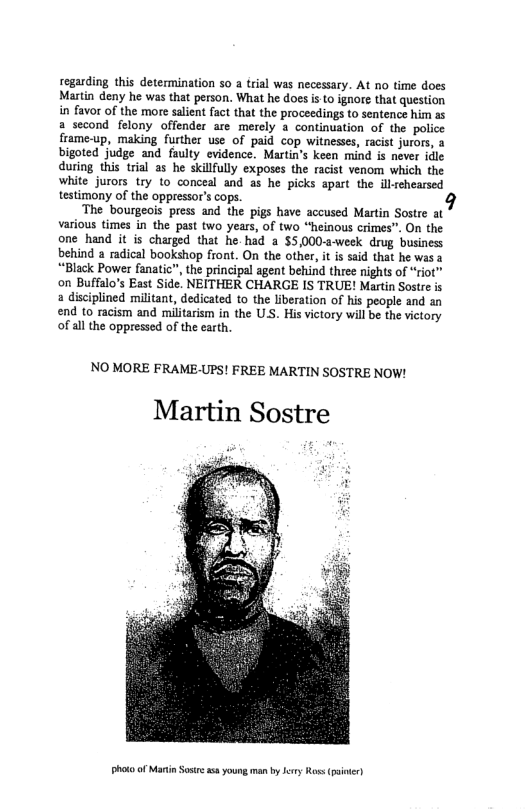
NO MORE FRAME-UPS! FREE MARTIN SOSTRE NOW!
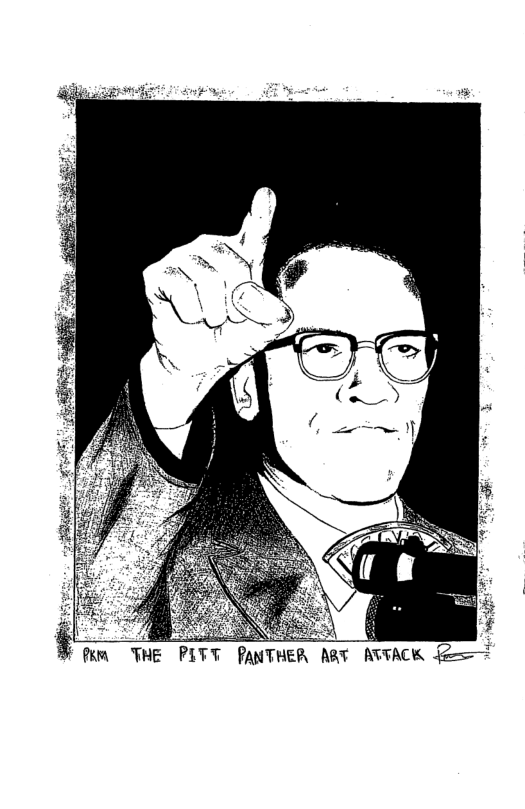
Martin Sostre
Photo of Martin Sosrea young man by Jery Ros (st
lo
19 FEBRUARY 1968
THE USE OF PSYCHIATRY
AS AN INSTRUMENT OF REPRESSION
With this hearing, called by the Court t0 set the stage
Jfor a much more momentous event, the reader is
introduced to the two main figures who will dominate all
that follows. On the one hand, Martin Sostre, thrust by his
bravery and wisdom 1o the very forefront of the struggle
against his people’s oppressor. On the other hand, Judge
Frederick M. Marshall, a man whose own words condemn
him: “[1 am] sick and tired of the long hairs, beatniks, the
ultraliberas, the unwashed, the exhibitionists. And
despise their marching, their singing, their bleating,
rabble-sousing, placard-carrying and card burning.” And it
may be seen that this pamphlet i not only about two men.
It s also a part of the much lager story of two historic
classes and two nations. The one, looted and decimated for
generations, the other powerful, armogant and morally
bankrupt are here locked in combat. Viewed in this way,
the story you are about to read i part of the global struggle
now unfolding against U.S. imperialism.
Martin's technique in this hearing was to question at length the
psychiatrists who were responsible for fabricating the report ‘on
Martin's mental state. At the very start he questioned a reference to his
race on the first page of the psychiatic report. He asked the doctor
(one of the psychiatrists who had written up the report) what bearing
race had on his evaluation. The doctor replied that, I took into
consideration that you were a Negro in rlation to a multiplcity of
other events that reiated to your background as you explained it.”
Martin was not very satisfied with this obscurantist answer. He
asked whether the doctor had taken into account the real condition of
the black people s an oppressed minority living in a white racist,
hostile environment. At this point the asistant D.A. jumped up and
objected that this was irelevant (ss he did some twenty o thirty more
1
times during the hearing when Martin raised this question). Judge
Marshall quickly sustained this objection as he did almost every other
that came from the Assistant District Attorney. Martin retorted that
Marshall was trying to block the hearing into his own iliegal actions and
demanded to know whether there was to be a hearing or not. Sostre
accused Marshall of trying to protect the doctor’s racist actions in
refusing (o let Martin ask him perfectly legitimate questions pertaining
10 racial oppression of Blacks in America. 1t s most revealing to watch
how American “justice” works out in practice in the American courts.
In'ths case, Judge Marshall was, in practice, passing judgement on his
own misconduct, Sostre thus temarked that, “Even Thomas Dodd
could not preside over the hearing against his misconduct! It's no
‘wonder,” Martin continued, “they call you ‘Mad Dog Marshall.”
Martin then returmed to his interrogation of the doctor. He asked
the doctor if it was possible for a court order to be used to have people
who are opposed to racism and militarism committed to mental
institutions. “Isn't it possible,” he asked, “that a_perfectly normal
person, opposing the political power structure, could be committed by
a judge who is controlled by the politicians and the power structure™
Martin asserted that he himself had been railroaded by the white power
structure, that Marshalls order to have him committed was an attempt
by a racist and bigoted judge to coerce and intimidate a black man
opposed 10 the power structure. The doctor answered in 4 tone of
professorial condescension that “This was possible”.
Martin had been characterized in the psychiatric report as having a
“paranoid personality.” Since this is a label often employed o slander
those who express systematic opposition to oppression, Martin wanted
10 set the record straight. Martin documented, in his argument, the very
veal nature of the oppression used by the rich to maintain their privilege
and power. He explained how, in his case, political pressure had been
applied to the law firm which first took his case to drop it, prejudicial
statements made by Police Commissioner Frank Felicetta and Assistant
Chief of Detectives Michael Amico had been given prominent coverage
in the press, the Afro-Asian Bookshop had been destroyed by the very
cops supposedly paid to protect property and the bail had been kept at
$50,000 despit its obviously exorbitant character given the charges.
Martin questioned the objectivity of the doctor and his “science.”
Since 1o scientific tests were used during the examination of Martn -
according to the psychiatrist’s own admission — was not the paranoid
personality label merely a subjective and perhaps even racist opinion of
the white doctor? Martin further asked what standards of objectivity
were actually used by the psychiatrist? The doctor answered, cbviously
Flustered that his twenty-five years worth of schooling had not prepared
him for such direct and “distespectful” questions, thet there were no
such standards of objectivity. It was mainly a subjective evaluation. He
insisted, however, that there were a group of factors which
characterized'a paranoid. One of these, he said, was hostility feelings
toward a person or persons.
Iz
Not paranoid - Oppresse
Martin asked the doctor f it were not true that feelings of hostility
toward persons o institutions may or may not have some real basis in
fact? Was it not true that a Jewish person in Nazi Germany would
manifest “paranoid” traits because of the oppression suffered there?
Was it not also true then, that an oppressed black man in the US.
‘would normally manifest such “symptoms?”
Martin quoted part of ah article from the American Journal of
Peychiatry on the effects of racial oppression on the mental health of
Negro troops overseas. The article condemned the too loose application
of the word “paranoid” to black people and implied that it was normal
Tor the oppressed to feel hostilty toward their oppressors. The doctor,
faced with this documented evidence, had to admit that Martin was
quite correct - in a raist society it would be normal for the oppressed
Black minority to manifest hostlity. “Then why didn’t you take this
into consideration in your report, doctor?” asked Martin, visibly
angered. The D.A. objected and his objection was sustained.
Martin then ssked whether a concer about the war in Vietnam,
the senseless slaughter of our youth, would not be considered abnormal
n the eyes of the ruling structure which sends the young men there?
“1f 2 person happens to be an oppressed black man in this racst society
and he fights back strenuously against these evils with literature,
specches and demonstrations, would not he, in the eyes of these racits,
be thought abnormal?” Again the DA. and Marshall interrupted and
prevented Marti's presentation from being completed. They ruled all
of this irrelevant!
Next, Sostre called upon another doctor who, like the frst, had
found Martin sane, but characterized by a “parancid personality.”
Under questioning this doctor admitted having heard of the black
rebellion in Buffalo the previous summer, the subsequent arrest of
Martin, the newspaper slanders against him, etc. However, the doctor
testified, al this was only of “epiphenomenal interest.” The escalation
in pseudovintellectuality was thus immediately evident,
‘Martin was determined to expose the racism of this stuffed shirt.
13
He asked the doctor to recall a conversation concerning mace that they
had had previously. On that occasion the doctor had asserted, “Well,
mace is better than a club, isn't t?” Martin had answered, “It is not 4
question of mace replacing the club but of it being added to the club,
the dogs and the gun as another terror weapon.” Martin asked the
doctors whether people’s moral positions and stands on issues of
conscience had an influence on the psychiatric evaluation they were
given? “Doesn’t one’s position on the pertinent moral issues besetting
our society - such as the vicious war in Vietnam and the oppression of
the weak by the rich - have great significance? If one’s stand on these
issues conflicts with the norm of society and its rulers - would it not be
labeled abnormal? Supposing | am fighting racism so that, instead of
semaining apathetic, I raise my voice - would I not be considered
sbnormal by the powers that be? Doctor, do you know that the two
biggest issues confronting this country are war and racism?” At this
point, the D.A. and Marshall cut in again, almost in chorus. Sostre
quickly shot back that Marshall was nothing but a political goon for the
power structure. A young woman in the gallery was, at this point,
signalling approval of Sostre’s remarks. “Get that woman out of here!™
Marshall screamed to the court guards, “Thats rght, get your goors,
Judge. You will have to use violence to cover yourself. You will have to
escalate just like the warmongers in Washington. You're another Hitle -
but we will use violence to answer your violence!"
“Get your goons, Judge!”
‘The young woman threw a kiss to Martin as she was removed from
the court by guards. Then Martin continued, “There are two moral
issues facing this country - war and racism. What are_your stands,
Doctor, on these two social matters?” The doctor used a well-womn
psychiatric trick to try to avoid the question. Instead of answering
concerning his own feelings, he tried to place Martin's ieas into
question. He said he recalled that Sostre had denounced the American
industrilists for the war in Vietnam and that Martin' considered the
Negro oppressed, put down and exploited and that Martin had seen
ulterior motives behind these social evils as well a5 behind s own
arrest. The D.A. again objected to the irrelevancy of the questioning
but Martin interjected: that it was his anti-acist and antimilitarist
activities which had singled him out in the minds of the power structure
as the perfect scapegoat for the vast social injustices of the ghetto
‘which the power structure had need to find excuses for.
hen Martin asked, “Does the individual have a moral obligation
and duty to mankind a5 a whole?” Objection! Sustained! “Would you
was” Objection! Sustained! “Would you not consider it sbnomal fo s
society 10 spend money transplanting hearts while at the same sy
they are stopping the hearts of nineteen and twenty year old youtha 1y
Yietmam?" At this, Marshal again interrupted. Martn angyly shor
back, “Get your goons, Judge! This is a kangaroo court!” 1y
1 surprise mote, Martin then called for Judge Marshall himself to
take the stand. Marhal efused and, sesing defeat, ruled the hearing
over. He furthe ruled that Sostre would stand tria, The guards pepas
Lo chain Sostre n the special manner reserved for him. HandeufTs oo
wriss were attached 10 shackles around his waist In 3 fas dopee:
e s he was led out, he clenched his fists and rasd them s high
a8 they would go. His supporters returned the saute.
5
4 AND5 MARCH 1968
A FINAL HEARING ON BAIL REDUCTION
AND THE MAIN TRIAL
On March 4th, 1968 Martin Sostre appeared before Judge Marshall
1o demand action on a show cause order Martin had initiated the
previous week. The order called on the DA. to show cause why
Martin's disproportionately high bail should not be reduced. The court
convened shortly after 10 AM. and Judge Marshall was quick to
dispense with the show cause order by vacating it and denying it
(although Marshall himself had signed the order). Martin observed that
in not allowing the order to be argued, Marshall was actually scting on
behalf of the DA.
Martin then tured to the spectators in the courtroom and urged
them “Watch racism in America. This is an example of a kangaroo court
in fascist America. Everyone remained silent in Germany but | don't
intend to make the same mistake. I want to be a personal example of
how you can resist legal lynching. They will not succed when you
sesist and expose them! | am being held in a dungeon. They put a
harness around me. This is done to no other inmate. They took al the
staples out of my legal material. I am solated inside the prison. There
are sympathetic inmates 50 I am forced to shave downstais in the
guards’ locker room. The goons have insulted the few visitors 1 am
allowed and a least one has been physically intimidated.
“But we are not going to the ovens like the Jews did. They were
aken unaware. We have leamed from their lesson. They did not die in
vain. The poor Jews in Germany didn't believe what fascism could do.
It s up to us t0 resist oppression and racism i all is facets, with all our
weapons. All the US. superiority in armaments - it can't prevail against
will and determination. Racism and militarism are two claws of the
same hawk!
“They tried to make me the scapegoat for last summer’s rebellion.
But they have adnmitted in the so-called riot repart the actual causes of
the rebellions. Even though little credence can be given to. that
whitewash report, they did admit that they could ot point to any
scapegoats, that conditions were the real causes. I have been vindicated
e
by even this whitewash report.”
While Martin continued to speak, Judge Marshall left the
courtroom. Martin read a lst of some thirty cases of inmates with lower
bails than his for much more serious crimes, including murder and
‘manslaughter. He pointed out that the stook-pigeon and police informer
10 be used against him was a man named Arto Williams, a known drug
addict, up himself on charges of robbery and grand larceny.
Martin then said, “No more cooperation with our oppressors! We
are going o resist them! What do they expect me to do? Say, ‘Yes,
boss, give me a rope and Ill put it around my own neck.” Racial strife
is created by the munitions manufacturers who are having a feld day
with the war in Vietnam and the city uprisings. Remember the example
of Nazi Germany, of what happened to the Jews, of how the Nazis got
to power. We don't have to make that same mistake. From now on we
are going to resist. It's peopl that count, not money and machines, not
power and guns. We must challenge the entire rotien foundation. We
‘must challenge everything they do, everything they say to cover their
crimes.
“The glare of national publiity scared them when Brother Dick
Gregory came st Monday. The court calendar is & very precise thing.
Yet my case was postponed last Monday when Gregory was here and
again last Thursday.” Martin then compared the position of the
oppressor to that of a murderer who must cover his crime. The
murderer i forced to compound his crime by the fact that he must
eliminate those who witnessed it. “Then he must get rid of the guy
watching in the window who has seen these new murders.”
Martin also related. the situation here o the Vietnamese struggle.
“Everyone they shoot in Vietnam is called a Viet Cong. The Viet Cong
are the people. Like in Vietnam we have our Uncle Tom generals in the
black community t00, the equivalents of Tshombe in the Congo. They
are just like those militarist generals, the sellout men, in Saigon. Not
one of our “leaders” in Buffalo has raised his voice (0 challenge the
insult of Felicetta! Felicetta insulted the entire black community when
he lied before the racist Eastland Committee in Washington, D.C. Every
one of those soalled black leaders went along. with the bal of
$50,000; they chickened out!”
Marin recalled the viciousness of the loca press in July and August
of 1967 when they made hay of the “outside agitators” and “fanatics
tied to June violence” and “Martin X,” etc. Martin asked, “What
happened to al these outlandish argumens? Either the ‘riot report out
of Washington is wrong o I am right. I am vindicated. I have to have
some sort of redress. Now that the black community and the
/7
enlightened people in the white community see that | am vindicated,
they want 1o know, why the continuing frame-up?
“They said that black fanatics started it. IF all this is a lie,
according to the ‘riot report, they have to give me justice! Look at how
they tried to bug me! If it wasn't for my Defense Committee | probably
would have been committed to the State Hospital by now. This i the
same tactic they used on the officer who questioned the Gulf of Tonkin
attack. They bugged him. They take you (0 a psychiatrist who puts
dope in your brain. They destroy you in the nut house. They were not
playing around when they had me over there! You should see the
vicious beatings the Nazi goons give the inmates over there at the
hospital
“The goons are an instrument used by the power structure. This is
incipient fascism and we are here to expose it. You on the outside and
me here in jail, from the dungeon. We wil fight it everywhere. We have
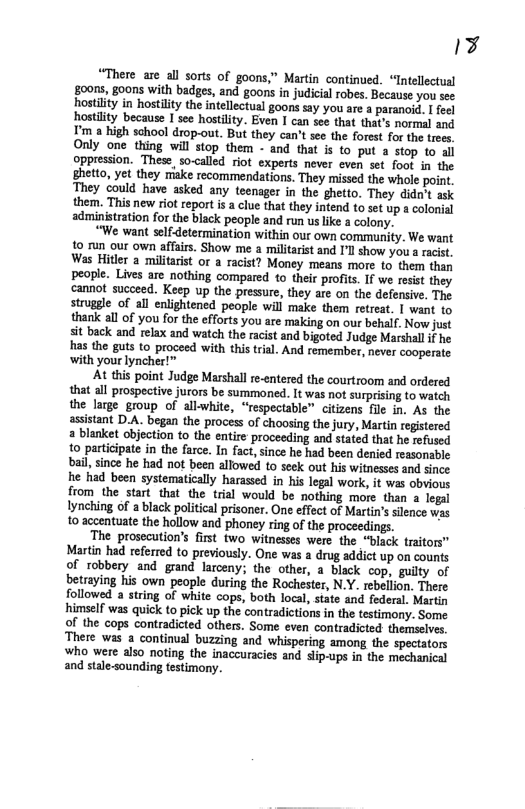
0 do something to expose it.” Martin then described the photograph
which had recently appeared in al the media showing the police chief
of Saigon exccuting a Viet Cong youth. “This is a photograph of
outright murder used by the oppressor o subdue the peopic. But in
every act of wrongdoing they show that they are murderers. | am going
to fight everywhere. This court is an arena. It is a battlefield - one of
the best. We wil use these same torture chambers, these same kangaroo
court, to expose them.
The murder of a Viet Cong youth
17
“There are all sorts of goons,” Martin continued. “Intellectusl
goors, goons with badges, and goons in judicial robes. Because you see
hostlity in hostility the intellectual goons say you are & paranoid. I feel
hostlity because I see hostlity. Even I can see that that's normal and
I'm a high sohool drop-out. But they can't see the forest for the trees.
Only one thing will stop them - and that is to put a stop to al
oppression. These, so-called riot experts never even set foot in the
ghetto, yet they riake recommendations. They missed the whole point.
They could have asked any teenager in the ghetto. They didnit ask
them. This new riot report is a clue that they intend o set up a colonial
administration for the black people and run us like a colony.
“We want selfdetermination within our own community. We want
o run our own affairs. Show me a militarist and I'l show you a racst.
Was Hitler a militaist or a racist? Money means more to them than
people. Lives are nothing compared to their profits. I we rosist they
cannot succeed. Keep up the pressure, they are on the defensive. The
struggle of all enlightened people will make them retreat. | want to
thanik all of you for the efforts you are making on our behalf. Now just
sit back and relax and watch the racist and bigoted Judge Marshall i he
has the guts to proceed with this trial. And remember, never cooperate
with your lyncher!™
At this point Judge Marshall re-entered the courtroom and ordered
that all prospective jurors be summoned. It was not surprising to watch
the large group of all-white, “respectable™ citizens fle in. As the
assistant D.A. began the process of choosing the jury, Martin registered
a blanket objection to the entire proceeding and stated that he refused
1o participate in the farce. In fact,since he had been denied reasonsble
bail, since he had not been allowed to seek out his witnesses and since
he had been systematically harased in his legal work, it was obvious
from the start that the trial would be nothing more than a logal
Iynching of a black political prisoner. One effect of Martin's silence was
to accentuate the hollow and phoney ring of the proceedings.
The prosecution’s first two witnesses were the “biack traitors”
Martin had referred to previously. One was a drug addict up on counts
of robbery and grand larceny; the other, a black cop, guilty of
betraying his own people during the Rochester, N.Y. rebellion. There
followed a string of white cops, both local, state and federal. Martin
himself was quick to pick up the contradictions in the testimony. Some
of the cops contradicted others. Some even contradicted: themselves
There was a continual buzzing and whispering among the spectators
who were also noting the inaccuracies and slip-ups in the mechanical
and stale-sounding testimony.
19
As the afternoon session drew 1o a close, Martin admonished the
spectators - many of whom were Afro-American youths from the
community_and student activists from the University - “Pay careful
ention! This is a farcical trial. They are trying t0 get rd of black
militants all over the country. Remember, if it can happen to me, it can
happen to you. When you oppose them, this is the treatment you get!
Continue to resist!” A middle-aged Afro-American raised his voice and
spoke for all friends and members of the Defense Commmittee. “We're
with you 100%, Martin!”” As Martin was led out to be taken back to jail
he received a standing ovation. An attomey in the court at the time,
obviously moved by Sostre's courageous stand and the show of
sympathy and solidarity he had received from the spectators said that
in his many years of law practice he had never before seen such 3
display of support for a defendant in the courtroom.
March Sth
When Court convened at 10:05 a.m. Marshall’ fist action was to
threaten the spectators with expulsion from the courtroom for 50 much
as talking, He said he would not stand for “indications of attempts to
disrupt these proceedings by gestures and talking .. The prosccution
then presented four more cop witnesses. They all knew at least the
general outline of the concocted story, that the stoolic and the black
op had entered Martin's store just before midnight on July 14th, the
stoolie had purchased heroin from Martin and Geraldine, they had then
had a rendezvous with more cops and returned to the store, aresting
the people inside (accounts varied on the number arrested a5 they did
on many other detail). The prosection then rested.
Marshall was now faced with a serious:problem. How could this
stage play of which he was principal architect and dircctor have any
semblance of a real trial if there was to be no defense? To head off total
catastrophe, a phoney effort of some sort was needed. Marshall decided
10 have two of the youths arrested with Martin contacted as possible
witnesses for the defense. Martin reminded the Judge that it was not
these youths who were crucial to the case but rather the four people in
the store at the time the alleged sale took place. Marshall then
announced that Court would be recessed until Thursday, March 7th, for
the purpose of finding witnesses.
When Court convened on Thursday, the fist order of business was
the status as regards the so<alled “defense witnesses.” Mr. Mintz, the
“public defender,” was the first o report:
20
Mr. Mintz: Your Honor, pursuant to your instructions, th resources of
the Erie County Bar Association Aid to Indigent Prisoners Socity were
‘made available to the defendant and Mr. Maloney and for the purposes
of investigating and securing_ or attemping 10 secure witnesses or
statements fiom witnesses on behalf of the defendant. Donald Dade, of
the Legal Aid Bureau, made an investigation and I expect him to be in
the courtroom this momin. I cannot sate first-hand what the results
of that investgation were. I did talk with Mr. Blumbers. Harold
Blumbers, the defendant’s fist-retained attorney, in an effor to secure
the names and addresses of witnesses and he indicated to me that they
had 10 names or addresses. He is not present in the courtroom but I am
sure he could be avalable, if necessary. I don't know if the Court is
intersted in anything further with reference to_investigation. I do
know that Mr. Dade indicated also that he did make contact with and
Jad an_interview with one of the two posible witnesses for the
defendant, a Charls Howard and Darrel Groves.
Marshall: He mentioned those o the Court the other day. Have you
spoken with the defendant?
Mintz: No, I have not. { intended to when I was originally assgned and
e chose not to talk with me.
Marshall: Mr. Maloney, can you tell us anything new other than what
ou told us the other day?
Mr. Maloney: The only addiional thing is tha I spoke with My Mintz
and Mr. Dade, and one of the witnesses that I had seen the night before
was here afte the Court adjourned and Mr. Dade proceeded to take his
statement. ] haven't seen M. Dade since, | have also talked with the
defendant and he said that he is not interested in those witnesses and
they are not his witnesses and that i that. | mean, that was Hisattitude
on the whole thing.
Soste: I regads (o these witnesses, Mr. Dade at about six-thirty ast
night was at the jail and this was the first time 1 had seen him with
regard 1o the witnesses. I gave him the same detailed description of
these four witnesses, not the ones that the Cour, that s the two
witnesses.that the Court is trying 1o obtain. These are the Court
witnesse, 1 imagine, this Darrel
Marshll: am not rying to obtain those two witnesses. Go ahead.
Sostre: [ have never subpoenaed any witnesses, but the Court has
employed a means outside of the scope of the Code of Criminal
Procedure to obtain witnesses which I have ot requested and the Court
‘has made much to do about appointing investigators and siatemens, |
believe were taken from these witnesses, a copy of which I have here.
One of them, by the name of Darel Groves, who incidentally i under
z/
indictment for the past cight months, has been under indictment as well
as the other, charged with Section 1533, subdivision 4 of the Penal
Law, which relates to frequenting a place where narcotics were sold,
and his statement here is very revealing. He states here that there was a
beating in the shop by police, that somebody was blackjacked, namely
me, that one of the persons in the shop, Geraldine Robinson, was
thrown on a couch. He also states that he was taken to police - that
there was an officer that pulled some narcotics out of his pocket and
said, “Ah ha, here it is.” He also states that when he was taken to the
Police Station, that Chief Amico stated, “If you know any information
on anything about Sostre, tell it and we will let you go.” There are a lot
of things here that weren't brought out by the parade of detectives
here. They didn't mention any .
Marshall: Are you addressing me or the audience?
Sostee: You, Your Honor.
Masshall: Al right then, look at me.
Martin then continued speaking. Though the statement taken from
the youth was a straightforward testiment to Martin's innocence,
Martin's main concern was to show how he had been prevented from
locating the main witnesses and how the Court was using these youths,
‘Who had, undoubtedly, been under considerable police pressure since
their arrests, to hide the gros injustice being perpetrated.
Sostre: 1 don’t think the defense is bound by any witnesses which the
Court may secure, particularly since the main witnesses have not been
Sought, and all of the efforts that the Court has made outside of the
scope of the Code of Criminal Procedure, since there has been a lot of
maneuvering in the Judge's chambers. There were conferences with Mr.
Maloney and the Court and the District Attoney in the Judge's
chambers on the question of witnesses. Yesterday, after the jury was
taken out, it was brought out here when Your Honor made statements
about this investigating. The jury does not know anything about this
because they were already out, S0 all this maneuvering behind the
scenes and these fellows that were charged with narcotics for eight
months, now charged with frequenting a place where narcotics were
sold. How can they be charged with that when I haven’t even been
convicted of a narcotics sale. There was never any marcotics sold at
1412 Jefferson Avenue. So you can see that the police were used in
order to frame black people in our neighborhood and silence all
opposition. This s why I am here. That is why I am resisting, t0 show
these things up, to. unfrock the fraud and the dirty double-cross and
frame-ups that the racist wiite power structure employs to subject or
subdue alldissenters and miltans, black and white.
Marshall: We have heard all that. 22
Sostee: No you haven'.
Marshall: These baseless and unfounded accusations you made, we have
heard before. If you want to stck to the isues, g0 ahead. If you don’
sit down.
Sostre: 7his s the issue here. So now I don't know what position the
Court s going 10 take. The Court s going around in circls, tying o
ostensibly aid me, when all it has to do is reduce my bail, because I
could recognize the witnesses. It would not take me any time to find
the witnesses who had been in the shop several times and whom 1 have
seen in the neighborhood but, because o the excessve bail I have been
prevented from finding them.
Marshall then begins to ask Martin more questions about the four
main witnesses, feigning a concern never before cvident in all the
‘months of Martin’s incarceration.
Marshall: How many are there? Three?
Sostre: Four,
Marshall: Are there four descriptions there that you gave?
Sostre: Yes.
Marshall: Where would you g0 to find them?
Sostre: Right to the neighborhood where I see them. They shop up and
‘down Jefferson Avenue. They have been in the bookshop several times.
Marshall: You don’t know the addresses?
Sostre: No. I can recognize them by sight plus they have been in my
shop to purchase records on at least two occasions before thislat time.
Marshall: AUl right, that i all. Thank you.
Sostre: And so, as | was saying, I don't know if these are your witnesses
or maybe Notaro's, the D.A.'s witnesses. Evidently he doesn’t want
them because he never brought them up.
Notaro: Your Honor, [ object t0 this.
Sostre: I don't know whose witnesses these are.
Notaro: 1 object fo this continued reference that he makes to these
Witnesses. These witnesses are out here. They are available i he wanis
them, and any other witnesses he wants us to subpoena, we will be
happy to subpoena therm.
Marshall: Al right.
Sostre: / did not ask for these witnesses without the other four.
Marshall: Let’s have Mr. Dade’s report. He is here now.
23
Dade’s report
M. Dade: Your Honor, first of all I would like to apologize for being
late in the court. I was out until four o'clock this morning trying to
complete this investigation and when you called or when your office
called I was in the process of writing it up ... Pursuant to the request
of the Court and also a request by Mr. Maloney, Clarence Maloney, who
advised me that he was asssting Mr. Sostre in this matter before the
Court now, I was asked 1o conduct an investigation with respect 1o
some witnesses for the defendant. In line with this, I interviewed M.
Sostre at Erie County Jail commencing at six ‘o'clock yesterday
afternoon and concluded at eight twenty-five p.m. yesterday afteroon.
Mr. Sostre confided to me that there were factors with respect 1o this
matter that indicated from the police raid that he was framed and that
certain illcit drugs that were allegedly found in his bookstore were
planted there and that there were four persons present in his bookstore
at 1412 Jefferson Avenue on July 14th, 1967, sometime prior to the
police raid of the store, Mr. Sostre indicated that these witnesses were
7ot present when the raid occurred. These witnesses were customers in
the store shopping for phonograph records. The witnesses as given 1o
me are described as follows: the first one, a man about forty-two years
old, six feet tll, one hundred-¢ighty pounds, dark-skinned, deep
sunken eyes and keen features. No name or address was given nor was
there any other distinguishing items s to scars, facial characteristics or
any other distinguishing features given of any of these. The second
witness as indicated, a woman, lightskinned, curly hai, sim, five feet
st inches,skinny legs, approximately twenty-¢ight years ld. The third,
@ man, five feet nine inches, medium brown skin, thick mustache, one
hundred sixty pounds, twenty-six years old. And the fourth witness, a
i, light-brown skin, five feet two o three inches, one hundred fifty
pounds, large breasts, twenty-two years old, smiles frequently and
wears a natural bush hair style, The defendant indicated that sometime
after the four witnesses, these customers, left, members of the Buffalo
Police Department and other law enforcement officials rushed into the
store and immediately commenced beating Geraldine Robinson and
when he went to_ her rescue he then was attacked by the police. The
defendant claims that police found no illcit drugs in the store nor did
they witness any sale or attempted sale. Defendant said that this is
police frame-up. Defendant indicated that Charles Howard, Darrel
Groves and a Johnnie Junior were present in the store when the police
=7
entered. He further siid that they were also phonograph record
customers. According to Defendant, Charles Howard received a brutal
beating from the police causing severe swelling of Howard's arm.
Defendant states that the police wanted to coerce Howard 10 confess
that he, Defendant, had been manufucturing Molotov cockiails,
Defendant stated that he did not want these three persons as witnesses
for the defense. He said that he wants the four witnesses that I have
already mentioned. An investigation which included a thorough search
of the business places, residences, and strets in the surounding area of
Jefferson, Glenwood, Woodlawn and Dupont Aveues in an effort to
locate Defendant’s four witnesses - Defendant desired and requested
that this be done - for a period commencing at 9:30 p.m. - I might
indicate here, Your Honor, I haven't written it in, but Mr. Sostre
indicated that this could best be done by him if he were out on bail.
Fora period commencing at 9:30 p.m. on 3/6/67 to 3:30 a.m., 3/7/68-
1 am sorry, 3/6]68 0 3:30 a.m. on 3/7/68, approximately two hundred
persons were -interviewed at taverns, poolrooms, residences, service
stations, restaurants, liquor stores and the streets in the area indicated
above. No one interviewed or questioned relative o the four witnesses
of the defendant knew of anyone either fitting the descriptions of the
witnesses indicated nor did they indicate seeing anyone in the area
around the date of the raid on the Defendant’s store. Defendant stated
during. the interview that only he could round up these witnesses.
Darrel Grove's statement
Defendant gave no names nor addresses and no other information
relating to the witnesses. The descriptions given by the defendant of his
witnesses from the interviews that I have had could fit any number of
persons frequenting the general area where the Defendant’s store is
situated, Prior to_the interview with Mr. Sostre, I did interview d Mr.
Darrel Groves who gave a statement relative 1o the events on the
evening of July 14th, 1967. The statement is as follows: “Darrel
Groves, being duly sworn, deposes and says that he is nineteen years of
age. Date of birth, October 16th, 1949. Residing at ...
Statement taken at Erie County Hall, Part 1, Erie County Court, by
Dorald Dade, Investigator, Legal Aid Bureau. I do not know Martin
Sostre but 1 know Martin Sostre from my presence in his bookstore
located on Jefferson Avenue near Woodlawn in the City of Buffalo,
New York. I was in this store on July 14th, 1967, at about 10:30 to
11:00 p.m. I went o the store to purchase phonograph record. Mr.
Sostre was conducting a fire sale on records. I noticed a young boy who
z5
1 know, who I knew 10 be Johnnie Junior who lves somewhere on
L Mr. Sostre was present in the store. 1 did ot know
Who Mr. Sostre was until a time later while we were both i police
custody. Also present in the store was a girl named Graldine Robinson
Who I know only by sight, having seen her from fime o fime. Chisies
Howard, who livesat ... . was also present with me when I
went into the bookstore. Charles Howard aso went into the store to
~purchase phonograph records. To the best of my knowledge, these were
the only persons in the store when 1 entered: Charles Howard, Murein
Sostre, Geraldine Robinson and Johnnie Junior. While Charles and
were in the process of looking through a stack of records and after
about three minutes from the time we entered the store, several
members of the Buffalo Police Department entered the stom. The
police rushed into the store and shouted, ‘Get up against the wall:
Some of the police officers were in uniform and some were. in
plainclothes. I don't recall exaetly how many there were. Charlesandl |
gt up against the wall at the first command. 1 did o see the others
ecause [ was facing the wall and did not tum around uncl ! heard a g
of noise and screaming by the girl. 1 looked around and 1 aw the police
attacking Martin Sostre. 1 sow one police officer grab Geraldine
‘Robinson and push her down into a couch; I observed a blackjack being
Geraldine Robinson -
co-defendant of Martin Sostre
24
used by a police officer. I saw a police officer with upraised - upraised
hand and swinging the blackjack. I cannot be sure that the officer with
the blackjack actually struck Martin Sostre. No one else present was
attacked by the police. At one point during the confusion the police
100k Sostre into a back room and out of my sight. During the time
from when I entered the store until the time I and the others were
aken out by the police, no one else entered the store. The police had
closed the door. While the police had Sostre in the back room they
subdued him and handcuffed him and threw him on the floor in the
Jront of the store. A police officer asked me my name, age, and what I
‘was doing there, and for identification. I told the officer my name,
address, and what I was doing in the store. I did not have any
identification. The same questions were put by the police to Johnnie
Junior and to Charles Howard. I heard Sostre ask the police to show
him a warrant. Sostre was handcuffed and on the floor at the time. I
saw a pollice officer show and hand a warmant to Sostr. I heard Martin
Sostre say, ‘You're trying to catch me selling pomography.” I don’t
know whether Geraldine was questioned in the store or not. The police.
conducted a thorough search of the store, I did no see the police find
anything illegal. I did hear an officer suy, “Aha, here it is." I bserved
the officer, who was standing right in front of me, pull packet of what
1 assumed 10 be a drug of some Kind out of his pocket. The officer
stated that he had found it in the back. Sostre remarked, If you found
Something, you put it there.” I and Charles Howard were handcuffed by
the police and taken o0 a police van where we were ordered o entr.
Martin Sostre was brought out and put into the same police van. I don’t
recall wat happened 1o Geraldine Robinson except that a police
Wwoman was brought in to search her. I cannot say what happened to
Johnie Junior. Charles, Sostre and I were. laken o Police
‘Headquarters. At Headquarters ll of us were searched. We were taken
10 the Narcotic Squad Room. The police told Sostre - _ the police took
Sostre 1o some other place. After Charles and I were in the Narcotic
‘Squad room, man known only to meas Lennie, was brought into the
Squad room. Chief Amico o0k me into the room where he siated, ‘If
you know any information or anything about Sostr, tell it and we will
let you go." I told Chief Amico, ' don't know anything."I told Amico
esentially the same things as I have indicated herein s regards why I
was in the store. At this, the Chief ordered me to be booked. I was then
booked and charged with frequenting a place where narcotics was being.
s0ld and used. Charles and Lennie were also booked and charged. We
were all amaigned in City Court where the cases are stll pending. T am
ot a narcotis addict and I do not use ilicit drugs. | never had any
Knowledge that drugs of any kind was ever sold in Martin Sostre’s
bookstore, or by Martin Sostre. 1 have freely and voluntarily made the
Joregoing statement without threat of any Kind and without promise or
reward of anything. No force or threat of force was used to elici this
statement from me. 1 have read and understand the statement and I
find it 10 be true in every respect.” And signed, “Darrel Groves.” I
conducted an investigation into the criminal record of Darrel Groves
and have a certfied copy from the Police Department that he has no
record outside of the case now pending against him in the City Court,
and this is as far, Your Honor, as I have gotten in the two days that [
‘have been assigned to do thisinvestigation. 27
Sostre’s rights denied, Notaro’s affirmed
Marshall: Thank you. All right, Mr. Sostre, do you have any other
witnesses other than these four that you claim?
Sostre: No. All I have are the four witnesses that ] have been asking for
and asking for reasonable bl to find them.
Marshall: Do you desie to call any other witnesses?
Sostre: 1do ot have any witnesses a this time.
Marshall: Do you desire t0 take the stand?
Sostee: At this time my attitude is the same. I am objecting 1o the
whole frame-up deal and I canno participate in this, because I am being.
denied opportunity 1o present a defense by being deliberately held
under bail higher than anybody else’s for the purpose of covering this
frame-up. This is what the Court uncovered accidentally just now. So
you know why I can't be allowed out there.
Martin is then asked if he wishes to take the stand himself or to
sum up. He repeas his refusal o participate in the staged farce and the
Judge threatens him with contempt of court. Martin replies, “Your
Honor, not only have I invoked my constitutional right to fair trial,
and the constitutional right to be afforded the compulsory process of
obtaining witnesses, the right of reasonable bail, the right to a fair trial,
but | am also invoking the right to selfdefense in order to defend
‘myself from being lynched.” Marshall attempts t0 interrupt but Martin
continues, “I have letters here that tate they took five hundred dollars
from us and withdrew from the case after doing two hours’ work. So if
the firm of Lipsitz and Fahringer can do that, I cannot put my freedom
in the hands of anybody else.” Marshall then declares that Martin has
waived his right to summation. He orders the jury retumed and then
signals Notaro to begin his summation.
Martin Sostre - Black Freedom Fighter
3)
14 MARCH 1968
THE TRIAL TO ESTABLISH SOSTRE'S IDENTITY
FOR CONVICTION AS A SECOND OFFENDER
On March 14th, Martin Sostre appeared before Judge Marshall on
an attempt by the Court to sentence him as a second felony offender.
Sostre was to be sentenced today for the conviction handed down on
March 7th. Martin, however, had appeared before Marshall carlier i the
week and had stated that he was going to challenge the
constitutionality of the present conviction and the earlier 1952
conviction.
While the testimony which follows speaks for itself it is important
to note that during this tril Martin was able to take a much more
active role than during the main trial. More for purposes of educating
his supporters than in any real hope of obtaining justice, he examined
the jurors and crossexamined the State’s witnesses at length. The brutal
racism of the jurors and the collusionist and deceitful character of the
cop witnesses which Martin uncovered show the tremendous talents this
“high school dropout” has developed in his years of struggle against
oppression.
The gag-prone judge
‘When the Court had been convened, Judge Marshall indicated that
he had provided Sostre with a statement accusing one Martin Sostre of
a 1952 narcotics conviction in Bronx County, N.Y. Marshall said that
with respect to_the statement, Sostre had the right to admit the
information, deny it or remain silent. In either of the later two events,
he was entitled to a trial to establish his identity. Martin said, “I remain
mute insofar as I am that person in that information.” Marshall then
called for a jury to be panelled.
3
Marshall then asked Sostre if he intended to envoke a challenge of
the constitutionality of the first conviction. Martin said that there was
o law requiring the raising of the question of identity and of
constitutionality simultancously. Marshall, however, ignored Martin’s
assertion and simply kept repeating the question, implying that, if
Martin was going to o it, he must o it immediately. The exchange
continued until ,Martin pointed out that Marshall was trying to
intimidate him and ssid, “T have the right to be tried by an unbissed
judge.” Marshall turned ‘blue at this and threatened to hold Martin in
contempt of court if he didn’t stop. Martin then said, “! have the right
10 be tried by an unbiased judge and 1 will always ask for that. You
cannot intimidate me by using Nazi tactics.” Marshall repeated his
threat. Martin said, “Get your goons, Judge! I want everyone to see
what you're doing. We will fight you right here in the courtroom!”
Marshall then called Sostre in contempt of court and said he would pass
‘appropriate sentence at the conclusion of the proceedings
Martin continued to speak. “We are resistng. This is war and you
know it. You are going to get another Vietnam right here!” Marshall
ordered Martin to sit down and shut up. The court guards surrounded
him but Martin resisted them and they, surprised by Martin's lack of
fear of them, stood motionless, unsure of what to do next, in full view
of the courtroom audience. Martin continued, “The fict that you are
getting resistance in the courtroom means that you are in trouble. We
are not going o let you intimidate us. Thisis war!” Marshall screamed,
“Get a gag!” to the guards. Martin continued, “You are a gag-prone
judge. But none of those gestapo techniques will work here. In
Germany, six million Jews were killed by Nazis like you. Too many
‘people there remained silent. But we are resisting you. Your system is
Eoing! Thisis war!” Again Marshall screamed, “Gag him!"
The court guards had, at this point, somewhat regained their
bearings after the colossal affront of being defied and hurriedly led
Martin from the courtroom. But not before Martin was able to turh to
the spectators and say, “You show me a racist and Il show you a
militarst. We are resisting fascism. Just like the partisans fought
Hitler!”
When Martin was returned to Court a short time later there was a
towel tied across his mouth and, after they sat him down, six guards
surrounded him. Of course, to proceed with the trial, Marshall shortly
had to order the gag removed. As this was being done, Marshall asked
Martin whether or not he was the same person who was convicted in
Bronx County in 19527 Martin retorted, “I want to challenge this jury.
T don't see any black faces here among these prospective jurors. |
demand to be tried by my peers, by my own people and those of
similar economic background to me, which is my constitutional right.
These.are not my peers!” he said, motioning to the prospective jurors.
‘Although there are over 100,000 black people in this area, theréis not
one black juror. This points out the racism here and shows tht the
black people are systematically excluded from cverything. We have here
white judge, a white stenographer, an allwhite jury .. . What kind of
Justice i this? No wonder racist Buffalo s going t0 bur!” 23
Conscience or “law"”
Marshall and the assistant D.A., whose name was Burke, began to
question the jurors, one at a time, s to whether or not they would take
the law the way the Court saw it or the way they personally felt. All
‘but a few said that they would follow the Courts dictation. Next,
Martin examined the jury. He took an approach diametrically opposed
to that of Butke. Martin asked the first juror, “Now, if you are dealing
with a situation, let us say, a situation dealing with conscience, and
your humanity tells you that the law is different than the judge’s
interpretation, would you go along with the judge or use-your own
head? For example, take the Vietnam War. Let us say we got an order
from.the Pentagon to send another million men over there, and then
another million, and another. Are'we to obey.this order because it is
given by the powers-that be? The federal government says yes. But you
are.an individual. Let us say that because of that law your own life is
placed in jeopardy and that all your resources are eaten up, that the law
s causing racial strife in the cities because the revenues are being used
for war instead of being fed into the cities to pay for the reparations
due o the black peopl for the longinflicted injustices. Would you
obey the law 10 the letter in this case or go along with your own
conscience? Would you blindly go along with the law or follow your
own-common sense and humanity?” The juror replied, “I feel that a
person should obey the law to the fullest extent.”
Martin asked the same question of all the jurors, geting the same.
type.of reply. again and again. Most stated, “I would go by the law
regardless.” or “T would obey ~the law.” Finally, one juror, the only
one dressed in work clothes (he had previously identificd himself as a
carpenter), stated, “I would apply my own thinking” Burke
immediately stood up and asked that this juror be dismissed. Marshall
t0ld the man 1o leave the jury box. Martin commented, “This shows
that anybody who thinks independently, not like a robot, who doesn't
80 along with the program, is not wanted. That's how Hitler got to
gm THE PITT PANTHER ART ATTACK de==—
(11925 1965
PKM THE PasT PANTMER ART ATTACK
26
power. That is fascism!” As the independent-thinking juror was leaving
Martin said, “There’s 2 good man. He thinks for himself. But under the
police. state you can't think for yourself. Under fascism it's not
allowed.”
Then Marshall asked Martin if he had any objection to the
remaining jurors. Martin answered, “I object to these illegal
‘proceedings. This jury, in addition to being all-white, has had everyone
with independent thinking taken out. Even the one who originally said
he wouldn’t go along, because of the mass coercion and the coercive
pressure of the rest of the jurors, was forced o change. Martin was
referring here 10 one juror who changed his mind about “the law” when
reexamined by Burke]. The only man with the guts to stick it out
against the pressure was taken out.”
‘The Court called for a new juror to replace the one who had been
semoved. After he was seated, Martin was given the opportunity t0
question_ him. Martin asked, “Sir, suppose your lfe were at stake
because a law you were following blindly placed your life in jeopardy.
‘Would you continue to follow this law blindly or would you use your
own thinking?” The juror said he would * ... follow the law.” Martin
then said, as he tumed to the audience, “Watch this closely! This really
shows what we'are up against, the seriousness of the massive coercion
utilized against us.”
Martin then stated that he wished to make further challenges and
proceeded to ask a juror, “Do any black people live on your block?”
‘The juror replied in the negative. “How do you feel about the racial
strife?” The juror said, “Don’t know.” Martin asked if he had read
anything about Feliceita’s or Amico's statements about who was
responsible for the “riots?” The jurors said, almost niformly, 1 don’t
secall.” Martin asked jurors if they recalled hearing of man named
Martin Sostre who was supposed 1o_be-responsible for starting the
webellion? He asked if they read the newspapers regularly, if'they
recalled a police raid on the Afro-Asian Bookshop after the “riots.”
Many jurors admitted reading articles about the rebellion and some,
rather reluctantly, admitted_hearing about the Afro-Asian Bookshop
and the police raid. Many of the jurors were extremely evasive and, of
course, Marshall only encouraged this. One juror denied being in town
during the rebellion but, when Martin pinned him down about dates,
admitted having been in town and having read the slanderous
newspaper artcles.
Martin then began to ask questions almost exclusively about race
and discrimination. He asked individual jurors if they had lived near any
“colored” people, did they live in integrated neighborhoods, did they
2l
ever socialize with black people, etc.? One furor, after admitting that he
ived in an all-white neighborhood, tried to-cover his rather obvious
racism by stating that he had associated with blacks whil he was n the
Navy during the Second World War: Martin, however, forced the man to
admit that at that time in the U.S. Navy, segrogation of blacks was the
official policy.
In reply 10 a white businessman who szid that he had one “Negro
employee,” Martin said, “It is impossible in this countay not to come
into contact with “them” even if you would like to avoid them. You
can’t help having occasional brushes with them. But 1 want to know if
you ever socialized with black people?” The juror said that he did not.
Judge Marshall called a recess.
“Do you believe there is racism in this country?"
After recess, Martin continved his intemogation in an
unquestionably successful attempt to bring out the subtle and
sometimes not so subtle racism of his so-called “peers”. What follows s
some of the rather revealing testimony of these people:
Sostre: You stated that you didn't live with Negroes. Would you object
toliving inan integrated neighborhood?
Juror: Some.
Sostre: What?
Juor: It depends on the type of Negro. Some aren'tnice.
Sostee: Well, isn't that the situation in your all-white neighborhood? It
s some people who are “nice” and some not 5o “ice”"
Juror: No. everyone in my neighborhood is ice.
Sostre: If your neighborhood were colored and so-called *nice””, would
you have any objection to lving there?
Marshall: The lady already said ro.
Sostre: Do you believe in open housing?
Marshall: Let's not get into philosophical discussions:
Sostre: Do you think you know about the problems, habits, situation
and circumstances of the black people?
Jucor: T worked with “one” so I know the problems.
Sostre: You mean you had “one” under your urisdiction, working for
you. You knew one “nice” Negro and therefore you know all the
problems. Do you judge al the Negro people from this?
Juror: One works for us.
Sostre: Where does he live? 3%
Juror: In an integrated neighborhood.
Sostre: Have you been ther?
Juror: No.
Sostre: Do you have any objection to black people lving in your
neighborhood?
Juror: Not f they are lawabiding.
Sostre: Do you believe Negroes should receive ther civil rights?
Juror: Yes, when they prove themselves capable of working.
Sostre: What do you mean? You believe they haven't proved themselves
- the black people built this country!
Jutor: Those that have proved themselves capable of working have what
they want.
Sostre: Do you believe that there is white racism in this country?
Burke: Objection!
Assistant D.A. Butke: Objection!
Marshall: Sustained. You will be stopped when I consider questions
improper.
Sostre: Have you had any other personal relationships with Negroes,
other than that one?
Juror: No.
Sostre: You don't socialize with any other black people?
Juror: No, just that one.
Sostre: /turning to another juror, a businessman] Where do you live?
Juror: Willamsville. [one of Buffalo’s poshest suburbs].
Sostre: Are there any black people in your neighborhood?
Juror: Yes, yes! Ermie Warlick. [wellknown sports announcer,
businessman and former football player].
Sostre: Any others?
Juror: Two more. The neighborhood i predominately white.
Sostre: Do you have any other relationships with black people?
Geraldine Robinson
and her five children
six victims
of a racist frame-up
Marshal: Sustained!
Sostee: You stated that you work in an allwhite office with one
Hundred persons. Is it ‘the policy of this company to exclude
Afro-Americans? Y2
Buske: Objection!
Marshall: Sustained!
Sostre: But this & a very important issue!
Marshal: It i insignificant to me.
Sostre: At least make a little show, Your Honor! Everyone knows it'sa
Jrame-up but you ought, at least, to make alittle show of conducting a
trial, [tuming to juror] In your determination of the issues of this
case you said you would go along strictly with the law instead of using
your own_conscience. You would go strictly by law regardless of
conscience?
Marshall: That's his duty and his obligation!
Sostre: That's where we differ, Judge, because a person’s conscience
and morality transcends the law. {tuming again to.the juror] You
Would go along with the Judge and what he told you? Suppose the
Judge is a racist judge?
Marshall: You can'task that question!
Sostre: You are o touchy about your racism that you are jumping the
gun. No wonder the black commurity is angry at you as well as the
entire enlightened segment of the white community. You can’t use
indictments to intimidate us any longer. We are bringing resistance into
the courtroom. You are finished with your fuscist tactics. We are
opposing you. We have to b this i order to bring out all your racism.
We have 10 oppose all these racists or otherwise they will continue to
oppress us. Now we are preventing them from hiding behind judicial
robes, playing the role of the benign judge.
Martin resumed his examination of the jurors and their deep-rooted
racism but each time his questions began to evoke their inevitable
seaction Marshall would block it. After one such interruption, when
Marshall told Sostre to_cither ask different sorts of questions or sit
down, Martin retorted, *“Your Honor, you are the one who wans to
continve with this farce. You would like me to sit down and stop
asking the embarrassing questions which get at the racism and fascism
here, Why don't you gag me again like you are trying to gg the
antiawar militants, the other dissenters?
Marshall felt the need for a recess at this point and signalled the
93
guards o remove Martin from the court. But Martin was not
immediately sienced. He continued speaking 10 the courtroom
Spectators as he was Jed out. “We have got o bring it out into the open,
expose it all to the public. It i the people who wil decide in the long
run, not those in power now. See - they can't even control their own
courts!”
“Sit him down!”
When Martin was brought back after the recess he addressed
himself to the Afro-American youths in the audienc. “Sock it to them.
Let them know how you think, especially now that SNCC and the
Black Panther Party have merged. With this development, it will not be
Tong until they are through.” Martin then resumed.his examination of
the jury. A juror who Martin had been drilling before recess had stated
that he knew of no discrimination in the U, Martin had been insisting
that this was very odd. He took up from this point in his examination:
Sostre: It s very odd that this man, lving in this racist society, has seen
no discrimination. Itis our duty to show him that, contrary to ks view,
white racism does exist, He stated that he was not aware of any
discrimination!
Judge Marshall: Sit down M. Sostre
Sostre: That's right, Your Honor, get your goon squad. That's how you
e rying 10 gag the dissenters. But its not going to work!
After completing his examination, Martin told the court that he
would challenge the entire jury except for jurors No. 1 and No. 6 for
cause. He stated, after Marshall refused to grant his challenge, that he
wanted to make an opening statement to_the jury. Martin began by
stating, “The fact that 1 was not allowed to challenge the jury - this is
the issue ... At this point Marshall interrupted and told Martin to
make his opening statement “in accordance with law.” Martin replied,
“The Naz's had their aw’ t00. You see what I am up against here.
Even the most racist person can see that this i a karfaroo court. The
issue in this case, a5 a lot of you have read, although you have not
admitied it; you know it, I know it, everybody knows it; is the
scapegoat the white power structure here has tred to make me into as
the cause for the rot. They refuse to admit ...
Burke: 1 ask the Court to direct Mr. Sostre to refrain from that type of
Opening. The opening, as I understand it is limited 1o what he intends
10 prove.
Judge Narshal: Tt i corecr, kg
Sostee: / ami going 10 tell them what 1 intend o prove.
Judge Marshall: Start on it then, sir. The other jurors that have not
een selected to sit are excused at this time. I will ask you 1o report at
fen o’clock tomorrow moning, 10 the jury selection room. Go ahead.
Sostre: The recent disturbance of kst year, the govemment has
admitied by the riot report, (which, incidentally is merely o
‘pacification program for the black ghettos which is not going to work,
Just like the pacification program is not working in Vietmam) was
caused by conditions.
Butke: [ object to that, Your Honor.
Judge Masshall: Yes, it is sustained. I will give you one more
‘opportunity 10 get o the opening statement. The proper procedure of
an opening statement is to outline what you intend to prove,if you are
0ing 10 prove anything,
Sostre: 1 am going o outline that.
Judge Marshall: Allright. start now, or else sit down. I will give you one
more chance
Sostre: 1 am taking this chance, f you willjust let me. The real ssue,
everbody here knows, is racism in America, that has split o country
Judge Marshal: All right!
Butke: / object!
Judge Marshall: Sustained.
Sostre: Miltarism
Judge Mashall: Mr. Sostre, you are going to tell us what you are yoing
10 prove.
Sostre: That s what I am trying t0 get to.
Judge Marshall: You are not going to be making speeches here.
Sostre: These are the facts I am trying to get to the jury.
Marshall: One more time and that is the end.
Sostre: Well, as I said before, the main issue here s whether this acism
that has our country spit is goin to contine.
Burke: / object, Your Honorl
Yshall: Sustined. Sit down, Mr. Sostre! You have waived you rght
to make an opening statement.
Blatt: 1 don't believe 1 have it with me here. Just a letter requesting me
10 come up and testify. P
Martin continued his questioning to show that Blatt might not have
actually remembered him since Blatt had had the opportunity to
examine and review court materials which would have femiliarized him
with the case.
Blatt: As to the trial, I brought up the indictment, the minutes of your
plea, and the minutes of your sentence.
Sostre: Have you read any of those minutes?
Blatt: I reviewed them before I came up; yes, I did.
Sostee: S0 you would be familiar with their contents?
Blatt: I refreshed my recollection from them, yes.
Sostee: So, therefore, you would not need any memory, now that you
have read.those documents, o state what they said, what is in them,
right?
Blatt: Well, [ would testify to my own memory. There may be certain
The East West Bookshop - Martin had rented
this storefront and begun to fix it up as a
branch store when he was arrested.
47
things I may be able 0 testify to, that do not appear in the minutes of
your plea and the minutes of your sentence. On the other hand, I only
read them hurriedly t0 refresh my recollection.
Sostre: But you did read them?
Blatt: Yes, and I remember this case personally. This is one of the cases
Iremember personally.
Martin persues the elementary point that Blatt's memory is really
itelevant since he has the documents. Blatt stubbornly defies simple
Togic as Martin asks:
Sostre: Mr. Blatt, regardless as to what reason you read them for, you
read these minutes, o therefore you would know what is in them,
whether you had remembered or not,is that correct?
Blatt: That i not s0. No, thatis ot correc.
Sostee: Now, you read the minutes, you familiarized yourself with the
contents of the minutes. Did you see any other documents or
photographs that would also refresh your memory @ to my
identification?
Blatt: The only thing I looked up were the papers in the fie.
Sostre: Did they include a photograph?
Blatt: No, they did not.
Sostre: Js it usual for a defendant - is it usual for a defendant to be
photographed at the time of his arrest?
Blatt: That would be with the police department. I didn't think it was
Jair o you, 10 look at a photograph of you before I came to identify
you.
Sostre: But the District Attorney has access to the police photos, does
he not?
Blatt: That is his business. [ wouldn't look at any photograph. I came
up to identify you.
Sostre: / said, the Distrct Attoney has access to the photograph?
Blatt: That isright.
Sostre: And had you wanted 10, you could have had the photograph of
Martin Sostre?
Blatt: Yes, ] could have gotten a photograph of Martin Sostre, yes.
Sostee: And also, you could have gotten firgerprints, i that correct?
Blatt: Yes
43
What Martin succeeded in doing through the many pointed
‘questions he asked Blatt was to put in bold relief the collaborationist
and mercenary nature of the “State's” witnesses. He undoubtedly
‘would also have demonstrated this lesson in the carler trial had he not
decided 10 refuse to cooperate in his own lynching as he aptly put it
When things not ordinarily questioned are challenged, the results are
sometimes instructive. Martin's questions exposed the mercenary heart
beating beneath Blatt’s “law and order” breast
Sostee: So this is just like you prosecuting another case in Bronx
County only a fellow District Attorney asked you o come up here and
give him a hand, and as a District A tiorney, this would be your duty to
o that, would it not?
Blatt: That s not so. 1 don't come up to give a man a hand, and I think
you know me well enough, from your contacts with me in Bronx
County, I don't do that.
Sostee: [ don't know you. I am asking you, is that correct?
Blatt: That i not correct,no.
Sostee: Who paid for the trip up here? Was this out of your pocket or
Burke: / obfect to that, Your Honor.
Marshal: Overruled. It might be interesting. Go ahead.,
Blatt: The District Attorney of Erie County.
Sostre: Did you eat today?
Blatt: Did [ eat? I had lunch.
Sostre: Is that part of your expense account?
Blatt: [ wouldn't know what they are going to allow me.
Sostee: But you would bill the state for that?
Blatt: [ expect to be paid for my fure.
Sostre: And your food?
Blatt: What food is there?
Sostre: If you ate lunch and whatever other expense you may have, to
sty ovemnight - suppose you have 1o stay overnight in a hotel room -
wouldn't this be a County expense?
Blatt: You don't expect me to pay for it myself, if I have to stay
overnight? 1 take it for granted the District Attomey of Erie County
would pay for it
Sostre: That is what I am asking you.
Blatt: don't want to stay over.
Sostee: S0 all of this is part of your duies and you will be paid for it -
Mr. Burke; he sent for you like you say, Erié County will bear the
expense of this,is that correct?
49
Blatt: Yes
Sostre: And every District Attorney in the State of New York, it would
be incumbent upon him to answer a call of another one in a similar
capacity, would it not?
Mr. Burke: 1 object to that, Your Honor, on the basis this witness
Wouldn't necessarily know whether it is incumbent upon every District
Attorney in the State to render such assstance.
Marshall: 7 would like to hear the answer, because I hope the answer is
yes.
Blatt: Yes, it is incumbent upon every citizen to answer a subpoena 1o
come to court, and in my case, he could have subpoenaed me, but he
extended the courtesy of calling me.
Sostre: This is different from a subpoena?
Blatt: If I said o, he would have subpoenaed me.
Sostee: Well, now that is a supposition - that didn't occur, The fact is
that you were sent up here and that this is a County expense and trip,
Now would you get time off for this in your job, as a District
Attomey?
Burke: / object to that, Your Honor, as having no bearing.
Marshall Sustained. This s a litte remote.
Sostre: No, it is o, because he said, “voluntarily" [ want t0 Know ust
How he gets paid, or whether the District Attorney's Office has allowed
him the expenses, his pay - will his pay go on or what? Whether this is
on his own, is he trying to make out ke this s on his own. I want to
know i hissalary i still going on.
Marshall: You are still being paid by Bronx County?
Blatt: /am stll being paid by Bronx County.
Sostre: In other words, you are acting in the capacity of a District
Attorney, is that correct?
Blatt: An ssistant District Attorney, that is corect,
Sostee: You are not just “doing your duty” like an ordinary cit
Who would rot set a full day's pay for their day's work -
comect?
Blatt: [ don't follow your question.
And 50 it continued, with Blatt dodging and ignoring the pointed
‘questions. Finally, at five p.m., Court was recessed to ten o'clock the
following Monday morning.
So
18 MARCH 1968
THE LAST DAY IN COURT
Marshall began the proceedings by directing assistant D.A. Burke to
call his next witness, Burke called Mr. Emmett Cochiane of Attica,
N.Y., an employee of the Attica Prison. The prosecutor moved (o enter
a photostat copy of fingerprints and some records marked as People’s
Exhibit No. 6. Cochrane identified them as commitment papers from
Sing Sing Prison that had been sent to Clinton Prison and then to
Attica. He also stated that he knew Martin Sostre, had had
conversations with him and that he could identify Sostre in the
courtroom as being the same person in the records.
Martin asked to examine the records. After doing so for several
minutes, he stated that he objected to the introduction of these
documents and that he had some questions to ask Mr. Cochrane with
regard (0 them. Martin then asked Cochiane when the photographs
were made. Cochrane said they had been done some time the previous
week. Martin asked, “Persuant to request by whom?” Cochsane
answered, “Mr. Burke.” “You received a call from Mr. Burke?” “Yes."
replied Cochrane. He continued that a Mrs. Smith had received the
original document June 25th, 1960. “Is she in the room?" Martin
asked. “No” replied Cochrane. The dialogue continued as follows:
Sostee: All you can suy is that you got a call from Mr. Burke and got
the documents photocopied. Can you say with absolute certainty that |
am the same person in those documents?
Cochrane: / am certain but | can’tsay with absolute certainty.
Sostre: The certain knowledge you o have comes from reading this
document, isn*t that right?
Cochrane: Yes.
Sostre: You have read the document? You have seen the photographs
‘and the fingerprints?
Cochrane: Yes
M
Sostre: Then you would have no difficulty remembering this
information since you_just looked at the photographs? All this
knowledge is what you just read. Your Honor, I object to this exhibit
being introducted.”This is no basis for an identification, completely
His testimony on his lap
At this point Burke again questioned the witness about whether he
knew Sostre and if he had scen him in Utica, N.Y. Cochrane stated that
he had seen Sostre at & court appearance in Utica. Martin. then
recrossexamined. “Mr. Cochrane, you stated that your records
indicated that 1 had appeared in court in Utica, N.Y. In fact, you are
reading those records right now, are you not!” Then Martin reached
over and pulled out the papers Cochrane had hidden from view. “Now,
Mr. Cochrane, it really wasn't 00 hard t0 identify me looking at those
hidden photographs, was it? This is the kind of fascist tactic we are
tying to expose. This is worse than what the goon cops use, worse than
what the fascist goon cops do. This is even worse than the fascist
‘methods of the racist courts down South. Thisi a real bonanza here. It
is not 0o often that we catch them with their frame-up tactics right
outin the open. Yes, thisis a real bonanza.”
Glancing at the hidden papers he had pulled out, Martin discovered
that they were a complete jail file on him and he began to read some of
the headings into the record. Most of the titles indicated disciplinary
action taken against him for political actvites at Attica. They included,
“Conspiracy to stage hunger strike,” “Agitating about the Muslim
Brotherhood,” “Distributing and writing Muslim literature,”
“Possession of law books,” “Having a homemade book in his possession
dealing with Muslim Brotherhood — punished thirty days.”
Martin saw in the fil a reference to a court appearance in Utica,
N.Y. “This is what you testified about?” Martin asked Cochrane. “No
wonder you remembered this without any trouble, you read it right
here.” Martin asked Cochrane if he could identify him without al these
documents, photographs and notes. Cochrane answered, “I can
recognize you exclusive of those.” Martin then noted that all
Cochrane’s testimony was completely worthless since he had hidden
and coached himself from the file.
sz
‘The next witness called by the prosecution was a Mr. Brryeyl,
senior LD. Officer at Attica Prison. He testified for Burke that he was
in charge of fingerprinting. Burke produced a set of fingerprints and
handed them to the witness. Brzyeyl stated that these had come from
Clinton Prison to Attica. Also produced were two sets of photographs.
‘The witness stated that the photos were pictures of Martin Sostre who,
he said, was “Sitting over there.” as he pointed at Martin.
Martin first examined the exhibits and then began to ask questions
concerning them. He first stated, however, that he objected to the
introduction of the photos and the fingerprints in that they were the
same identical set that Mr. Cochrane had used. They were only “copies
of copies,” not the Sing Sing originals. “These records came to you
from Clinton Prison, right?” The witness answered that this was true
and that persuant to Mr. Burke's request he had had copies made. He
said that he had compared the two sets of prints and they were
identical. Martin asked him ifhe was a fingerprint expert. He said yes.
Martin then got him to admit that he was not present when the prints
were made and tht the only reason he knew the prints were Martin's
was that he had read the records in front of him earlier that moming
and the name “Martin Sostre” was affixed to them. He did not know
who had received the prints from Clinton and could not be sbsolutely
certain they were received in Attica since he had no personal knowiedge
of such reception and had only read the notation. He also admitted he
was not present at Sing Sing or at Attica when they were made.
A “photographic” mind
Next, Martin asked the witness if he had gotten the photos out of
the file upon the request of Burke and Brzyeyl admitted the photos
were the same as those of Mr. Cochrane. “How many photographs have
you taken?” Martin asked. *23,000 was the answer. He asserted that
e had remembered “quite a few"” of the 23,000 faces. “Mine stood out
in your mind over all the other thousands?” Martin asked. Brzyeyl
replied that he had been late that morning and had had to take other
photos and that was why he remembered Martin. Martin helped him
semember, however, that this situation had occurred many times and
there was nothing really distinctive about it. So Martin retumed to the
original question. What was it that stood out about him that was
responsible for the witness's remarkable memory? Brzyeyl said that he
recalled that the guards had brought Martin “from upstairs down.” This
was another dead end, however, since he then asserted that “a lot of
$3
times” they brought prisoners “from upstairs down.”
Martin persisted. “What was it in all the thousands, what
distnguishing feature in this face stands out among all those
thousands?” The witness decided that it must be Martin's receding
forehead. Martin found this assertion a litde more unbelievable, “But
this is quite a common feature. In fact, right here in this courtroom we
have a balding jury, judge and stenographer.” Brzyeyl then explained
that the thape of Martin’s balding head was what was so distinctive.
“What shape?” Martin demanded. “We understand that no two
foreheads are identical.” Brzyeyl said that it was the “roundish”
character which made the balding forehead so distinctive. Martin
retorted, “Roundish! Would other heads be square? All heads are
roundish.” Faced with this elementary observation, the witness soon
became totally unresponsive. Martin tumed from the “witness” and
demanded of Judge Marshall that the documents be thrown out as
totally worthless. Marshall, as before, refused.
‘The next witness was assistant D.A. Peter Notaro who testified that
he had been the prosecutor during the earler trial. He was present on
March 7th when the verdict found Sostre “guilty 2s charged.” Martin
asked Notaro if he worked out of the same offics as Burke, whether or
ot they both had occasion to prosecute the same case, and handle the
same files? Notaro nodded that this was true, The last witness called by
Burke was the assistant Chief LD. Officer in the Buffalo_Police
Department. Martin objected to the introduction of a set of prints
taken in Buffalo and in Attica that Burke offered the Court. During
questioning, the officer stated that it was true that he had no way of
estimating the age of a given set of prints. It was impossible, from the
print itslf, to tel when it had been obtained. “In other words,” Martin
reasoned, “These prints [supposedly from Attica and Buffalo] could
just as well have been taken simultancousy. As to how far apart they
are in time, you would not be able to testify. Any date could be put on
this card.” “That s posible.” the officer admitted.
Martin moves for dismissal
Martin moved 1o have the documents throwh out. Marshall
immediately overruled him. “The People” then rested its case. The jury
was excused by Marshall who then said, “We are going to hear any
‘motion the defendant may have.” Martin began his motion to dismiss
for failure of proof. The prosecution had not proved its case. He also
59
Buffalo Evening News, June 21, 1968
Felicetta Links Red Group
To Disorders in Buffalo
By ROLAND POWELL
Buttaio Evening News Bures
WASHINGTON, June 21 — Persons linked o a Com.
munist splinter group were active in encouraging last
June’s racial disturbance in Buffalo, Police Commis.
sioner Frank N. Felicetta testified Thursday betore the
House Committee on Un-American Activities,
M. Felicetta said that Buffalo] ————————
Debice Photographed a number Black Muslims and other black
wrihrsens handing out literwture nationalit groups wepe cetie ok
hich, he said encouraged_ the|encouraging the riotng. e i
Coting, and later pickoting Erie labeled Martin ~Sosies "y "¢
County Jai, where alleged icader of the predimirionc:
Thoy "acr being held. He said|agitation, including insimeee
they were identified as being|yauths in the use of il
fonnected with an organization cockiails, Sostre. recenty oy
Yo as Bullalo Youth Againstconvicted on marcoqes churmrs
War & Fascism (YAWF). Mr. Felicetta said tha tlyars
Chester D. Smith, "goneralldistributed. by m e m b1y of
gounsel of the commitiee, placed| YAWF “told" the Nogrocs thor
in_the record a statement by|life held no fature Sor shen:
FBI Director J. Edgar Hoover|except poverty and serviee iy
that YAWF is a youth group of | Vietnam.»
Cmavorkers World Party, 3 “These lealets charged that
Sommunist “splinter” organiza- Buttalo city offciats s pem
son. were involved in an orgamized
Mr. Felicetta also told the|repression of Negroes ja. f
committee that members of the| fly-:’ the commissioner eon-
inved.
S5~
‘commented that he desired to sum up to the jury when they returned.
In his motion for dismissal of the “information,” Martin stated, “I
move to dismiss because of the parade of phoney witnesses, the hidden
photographs utilized, the slfserving witnesses, all prison officials, Not
one independent witness has been brought forward to positively
identify me. I have strong objections with respect to law and especially
in rogard o the jury.” Martin aserted that the jury had been
intimidated and that questions of conscience were at issue. He said,
“There have been issues of conscience and morality that the jury has
been precluded from hearing.
“The Tribunal at Nuremberg, of which the USS. was a party, ruled
that if the law goes against one’s humanity and conscience, it is the
duty of each individual citizen to oppose this law, especially when it is
used by tyrannical govemments 10 oppress the masses. This decision
was reaffirmed by the courts of Isreel that tried the Nazi, Adolf
Eichmann. Eichmann also was repudiated when he stated that ‘T was
just following orders. Eichmann had been given the seal of approval
from the state, the duly constituted government of Germany. Yet all
this was repudiated. The Declaration of Independence tels us we must
oppose and resist the unjust laws of the government. In the courts of
Cuba, after they overthrew Batista and his fascist goons, the goons
repeated the pleas of the Nazis that they were ‘strictly following the
Iaw." But this was not accepted. In New Rochelle, N.Y. the Federal
Court riled in a case which concerned an Afro-American group
picketing to integrate a segregated school. They had been enjoined by
the city not to picket, but they disregarded this order. The judgs ruled
that, according to the Doctrine of Legitimacy of Purpose, it i the right
of a person 1o break the law in order to exercise one's preferred
constitutional right to dissent,
The UN. Declaration of Human Rights states that a govemment
can no longer hide behind sovereignty when they are committing crimes
sgainst humanity. This is why Maloolm X was asassinated. He tried to
80 to the UN. to bring this racistfascist country before world
condemnation. According to the Sth, 14th and 16th amendments to
the US. Constitution, one is guaranteed his liberty and, according to
the 6th amendment, has the right to trial by an impartial jury. This
sight has been precluded in this case when Your Honor had the only
freethinker yanked out - 3 workes -a person who was going to make up
his own mind. He was taken out. The other was made to change his
mind by the coercion of the D.A. and the other jurors. In view of all
these decisions, the International War Crimes Tribunal at Nuremberg
that told the Nazis they could not hide behind the law, the tril of
Eichmann by the Isracli Courts, the decision of the Cuban Courts to
execute the fascist goons of Batista, and all these reaffirmed by “The
Doctrine of Legitimacy of Purpose™ which states that we have the right
to fight againgt tyranny. This law says that I have the right to resist 8
tyrannical law and any other used t0 oppress the people.”
Judge Masshal finally broke in and told Martin to stck to the low
in making his motion. Martin retorted that, “I am asserting a multitude
of laws .." Marshall interrupted, “We wil not argue any social
questions here.” “This s a social issue.” Martin asserted. “Stick to the
Law.” Marshall demanded. “But law itslf is part of this case. Issues of
law are involved here. The Nuremberg decisions are a higher law than
yours ... Marshall demanded that Martin begin his summation.
st
Martin’s summation
Martin walked over to the jury and began. “You have just heard
the evidence and have seen the methods the fascist state uses to destroy
all those who oppose it. You have seen the crude methods used by the
racist white power structure to frame-up black men. This has 10 be
exposed because that's how they frame-up innocent people. This is no
heassay. We all saw it. The D.A. representing Bronx County and al the
other selfserving officals were the only witnesses,all of whom have an
interest in common with the prosecution. That is the way they frame
people. They either plant dope or a pistol or anything to get rid of the
diswenters against the state. These are the methods Hitler used in
Germany in order to destroy the Jews and all those who opposed
fascism ....” Judge Marshall interrupted the summation to tell Martin
to stick to the evidence. Martin replied that he was getting to that, he
‘was establishing the foundation for the remainder of the summation.
Martin continued, “These are the methods the racist-fasist State
must use and employ because it has no real proof with which it can jail
the oppressed. The use of hidden photos, no independent witnesses,
only self-srving state offcials being coached with hiddon documents. If
this is US. justice, we might as well be in Nazi Germany. We are
fortunate to see it for ounselves. I am facing thirty o more years
because 1 had a bookshop that sold literature against the system. 1 am
facing thirty years because I went against the system. You all read
about the case. Now the D.A. is trying to give me double the sentence
by making a phoney identification. None of you have taken into
consideration common factors of humanity. Only one man stated that
e would not go along with the duly constituted authority. But Adolf
s7
Eichmann was tried and executed for following blindly the duly
constituted authority. Nazi Germany gave him the official seal of the
State but the Israeli Courts threw out that argument. The War Crimes
Tribunal at Nuremberg originally affirmed that it is one’s duty to
oppose unjust law. Why even the most vicious goon would be blameless
i that defense, that I was ‘just following orders’ were to be accepted.
“Even the govemment itself breaks the law. It has violated the
Constitution by sending our boys over to Vietnam to be killed and to
‘murder innocent peasants in a war that has not even been declared.
They broke the law but they want you to go by the law. Very nice! We
are 4ll Tobots! We are supposed to follow the law blindly regardless of
‘humanity, regardiess of the consequences. “Let us oppress these black
people. Let us send more cannonfodder to Vietnam.” Very nice! Six
‘illion Jews perished ...” Judge Marshal again interrupts by yelling
“Get to the evidence!” Martin answers, “The evidence speaks for itslfl
We all saw what happened! The law is alaw of tyranny. Even the Bill of
Rights - the highest of al law - aid down the principle of opposition to
law and advocates rebellion when law becomes oppressive and
tyrannical. If the Declaration of Independence had not laid down these
principles, then Briish law, the law at that time, would have never been
Opposed and there never would have been 3 evolution! So what s this
Tave that you are supposed to follow? That you must follow blindly?
These are issues of conscience.
“You can't go along with these fascist tactics unless you go along.
with the program. That's what the Nazis did. But this has already been
Tejected. The Nuremberg Tribunal states that it is the duty of every
individual citizen to oppose unjust law. This was already handed down
by the U.S. Constitution which states that a man must be given Liberty -
Lberty of thought - and has the right to a trial by an impartal jury, 2
jury with conscience and humanity, not one that wil follow an unjust
Taw. This country will not last long if it follows unjust law. The gold
drain, the war in Vietnam and the black rebellion are evidence of this.
“The fascist goon squads have MACE, which is chemical warfare
for use against the black people. The ghetto youth, however, have
LACE, which islye-in-the-face. If you are goin to use chemical warfare
on us, we are going to use chemical warfare against you.” Marshall
interrupts and says that the race issue is not important to the jury and
that, “We are not going to argue it.” Martin quickdy’retorts, “That's
what all the racist and fascist judges say. We all saw the phoney
evidence, caught the goon in the act. We all saw the frame-up. This is
Something everybody saw. These are the issues in this case, not just this
5%
information, but the more serious implications involved, issues of
humanity and conscience. We must expose fascism. Dissent has come to
the Gourtroom, just as it has come to alllevels of society: in the streets,
in the universites, in the homes. This i the real issue. How to stamp
out fascism ‘and fascist methods. Spock, Ferber and Goodman were
indicted because they dissented. In addition, black militants and their
‘white alles have ben framed-up because they dissented from the rule
of fascist goon squads ... Marshall once more butts in, yelling, “1 will
waive your right to summation!” Martin seplies, “Of course you would,
Judge. You waived my ight to get my four witnesses. All this will be
light stuff compared 10 that!™ Marshallagain yells, “Sit down!” Martin
continues his summing-up. Ignoring the judge’s threat, he turns o the
jury and the spectators. “The racist tyrannical Court is just an
instrument of the police goons. They frame you and then bring you
here. State offiials are brought in to complete the frame-up. | want to
expose it for all Buffalo to sce. The goon had hidden photographs and
records and was reading from them. Judge Marshall saw the whole thing
from where he was sitting and said nothing. That, in itsel, speaks
volumes. I exposed it for all of Buffalo to see. It has all been worth it
just to expose the methods that state officials wil go through in order
{0 frame 2 man who opposes them. Your own common knowledge,
your own conscience, these are the sole determiners that will tell you
Whether or not this issue should be dismissed.
“I you do not oppose these laws, you will be helping the fascists
to take power. Even if they send me (o Attica, you are going to see
more of the same. After | go there will be more of the same. In fact,
right now there are several prisoners in the Erie County Jail who will
defend themselves and will oppose you right here ... “Stick to the
issues, Mr. Sostre!™ yells Judge Marshall. “This s the law, this is the
issuel”™ Martin shouts back. “Argue facts!” shouts the judge. “Thisis a
higher law than the jury has a right to decide. The issue is a man's
natural rights. The laws of the tyrant do not rule over the natural rights
of man .. “I will waive your right to summation!” Marshallscreams
again. Martin reples, “Waive my rights, just lie you are waiving the
fights of the other dissenters, framing-up those who oppose the rule of
fascism.” Marshal retorts, “Stick to-the rules, Mr. Sostre!” “I'm not
following any fascit rules!™ Martin insists.
Beyond a reasonable doubt
At this point, Marshall orders Burke to sum-up. Burke's summation
i
is short and his voice is 50 low that Judge Marshall has to ask him to
speak up. Next, Marshall charges the jury and they are sent out to
deliberate. After Tunch the jury comes back out to see the photos and
fingerprints which they pass around to each other. They then go back
into deliberation and shortly afterwards retum with their verdict. The
foreman announces their finding: the prosecution has proved beyond a
reasonable doubt that the information was correct concerning the
identification.
Marshall now advises Martin to make any constitutional motions or
forfeit the right to do so. Martin moves for dismissal of the information
of the 1952 conviction on the grounds that at the time the guilty plea
was taken, October, 1952, the D.A. Blatt had violated the Code of
Criminal Procedure and the decisions in The People vs. Codarre and in
The People vs. Brossit which emphatically state that the faiure of the
D.A. to follow the correct procedure does not nullfy a plea. Blatt had
used this trick as grounds for rejection of Martin's plea in the 1952
case. “This outright mistepresentation is in violation of the Sth
amendment. I ask that the Court take judicial notice of the exhibits in
this case and move that the information be dismissed because that
conviction s founded upon unconstitutional methods.”
Marshall immediately snaps, “Objection overruled!” and denies the
motion. He then asks Martin whether he has any legal cause why the
judge should not now pass sentence. Martin states that he has many
reasons. “This conviction, if it can be 5o called, is founded upon the
most flagrant. maneuvers, unscrupulous methods and outright fascist
tactics from selfserving state witnesses (o the denying me my right to
witnesses by means of exorbitant bail, higher than anyone else in Eric
County Jail, thereby denying me my right to prove my innocence. This
was so flagrant that the Appellate Division wants to review the fact that
T was denied fai bail, held eight months in the jail without being able
to teach my witnesses, forced to trial without my witnesses. The reason
for al ths s clear: Because I opposed the power structure of this city, [
was the owner of the Afro-Asian Bookshop which sold antiwar and
black nationalists and liberation literature. 1 had been visited by the
Subversive Squad, the FBI and local police who had told me to stop
slling this kind of liteature. T refused and continued to disseminate it
even after the contents of the shop were destroyed by the Fire
Department who, on the pretext of putting out a firé, broke in the
windows and tumed their high-power hoses on the literature even
though there was no fire. After I disregarded this intimidation and
attack, my shop was raided by the goon squad and I was charged with
Buffalo Courier Express, February 12, 1969
‘Custody Situation’
State Official Denies
Sostre in ‘Solitary’
State Correction Commissioner
reported
a5, Moo ol n o v ol o i
3 charge by ihe Marti Sos. particpaing. iz
{re Defens Commiton nak So. | cousslng and ssang - ame
e is_in “sollary continement”| quesons” about his Jvolverment
in Green Haven Priso, Sor | back miant grup.
Martin Sostre, 45, formerly of was placed a seprogation
112 Jefferson Ave, 'who Fas bec i oiner
1 St has sy it
partic sroup counseling,
or in recreational activies,
placed 1o lv(re’::‘nn;“ll:rmnpeu-
trying 1o incite the lomates,
icGinals said.
o
41
inciting to riot and arson. The four persons in the shop besides me were
also charged with crimes. These are the fascist mothods that the
fascistracist power structure must employ in order to silence the voice
of dissent. It follows a pattern all over the country where dissenters are
being framed.
“The show here this morning in which a police official was
deliberately hiding documents while right on the witness stand shows
the methods they have to use. All the witnesses were previously
coached as we saw. We actually saw the fascist methods that had to be
employed in order to obtain a phoney identification. It was the same in
the tril. The D.A. and all the witnesses, except for the stool-pigeon
who, everyone knows, would testify on his mother,outside of him, all
the ones who have accused me were police officials, state officias. Not
one independent person, not one citizen of Buffalo not on the payroll
of the goverment testiied against me. All those selfserving witnesses
had an interest in the case. They all had a job to do, an interest in
secing a conviction. So on these grounds, o manifest to al here, in
“ddition to the fact that all my pleas to have my bail lowered to the
same level as given to other prisoners were refused, that the judge
would sign a show-cause order and then, later, kirt the issue that the
‘people of Buffalo wanted to hear, namely, why the DA. had set such
exorbitant bail. Even now this has never been cxposed and at the last
‘minute the judge arbitrarily denied a hearing (o have the show-cause
order argued, thus covering up for the DA
“The reason i clear. If they could have identified me they would
have. The fact that I have resisted, this forced them to utilize fascist
tactic. 1 have uncovered this. If we don't expose these tactics, they will
never be exposed. We have to resist them in the streets, in the schools
and in the homes. In court we must resist them. Otherwise, their lies
and contradictions will not come out. If we all follow the law blindly,
and the issue of law is clear on that, the fascist take-over will come
Sbout with no opposition. The Nazis had received the offical German
Seal from the duly constituted government. Yet this excuse was rejected
at Nuremberg. It is our moral obligation, on all these grounds, which
are all well known and are on record, and on laws that were handed
down most recently, to oppose racism and fascism.
“So on all these grounds, 1 move that the sentenge be suspended.
and that 1 be allowed o g0 to the Supreme Court chambers for the
Justice’s signature on a certificate of reasonable doubt, so that he can
review the kangaroo frame-up this court is trying to pass. Judge
Marthall, when witness Cochrane was on the stand, not once did you
admonish him not to read those hidden documents.” Martin turns back
0 the spectators. “He went along with the program. He was looking
tight there while it was happening and yet didn't say a word. This
shows the kind of court, the racist judge and jury, we have here, how
‘ourt officials frame all militant voices that oppose oppression!”
Judge Marshall once again breaks in, “You are vicious and violent
person, motivated by nothing but hate.” Martin ignores this comment
and demands to be allowed o go to the Supreme Court chambers.
Marshall, without even answering the demand, proceeds 1o pass
sentence on Martin: 25 to 30 years on the first count, 5 to 10 years on
the second count, 1 year on the third count and 30 days for contempt
of court.
Martin turns and smiles to the supporters and members of his
Defense Committee. As the court guards lead him out, the handcuffs
once again in place, Martin raises his clenched fists. “Keep resisting,” he
says, and then he is gone. It s only later discovered that one hour after
the sentencing Martin is already being rushed by car 1o Attica. A day
later, a second offiial veficle whisks Martin further from his
supporters. Martin is transported four hundred miles to Green Haven
Prison outside Poughkeepsic where he has been in solitary confinement
since June 25th, 1968,
b
é
A POST SCRIPT 3
The Martin Sostre Defense Committee (MSDC) was
formed at the beginning of August, 1967, in an atmosphere
of reaction and repression almost unprécedented, even in
the right-wing, banker-dominated city of Buifalo, New York.
The black community in Buffalo had exploded inlate June ~-
there was a great deal of back pay due for the hundreds of
years of exploitation they had suffered, living in the Bir-~
mingham of the North, and consequently, the rulers trem-.
bled. They immediately ordered a merciless counter-
attack in the form of indiscriminate terror. Pigs with guns,
tear-gas, clubs, dogs and high-pressure water hoses were
used ©0 try to terrorize the black population back into sub-
mission. There were numerous arrests and beatings. All
this, however, didn’t satisfy the bankers and induscrialists.
They gave orders to the police to find a scapegoat. That
they themselves had caused the rebellion by their contin-
uous 10oting of the poor over many generations must not
be found out. A big lie was necessary and they decided,
with all the brainwashing power of their newspaper, radic
and TV monopolies, to tell it. They blared it into every
home on the Niagara Frontier: Martin Sostre Caused the
Rebellion.
Martin's friends, though fully cognizant of the serious-
ness of the attack on Martin and the determination of the
ruling forces to see the lynching through to its wretched
end, rallied to his defense. In these first weeks the golng
was particularly rough. Several of Martin’s closest friends
were arrested with him. Not all were as strong as Geraldine
Robinson, who, though facing very serious charges for
having worked with Maxtin to spread the message of libera~
tlon, fought defiantly by taking the story of the frame-up
to the black community. Several other friends were beaten
and threatened with long prison terms if they didn’t stop
their efforts on Martin’s behalf. One friend was forced to
move to another city to escape abuse and threatened punishe.
ment for aiding Martin. In addition o all the attacks on in-
dividuals, a huge propaganda assault was unleashed in the
local media. It was said, for example, that Martin had been
engaged in a $5,000 per week business in narcorics traffic
(strange then, that he lived 50 humbly and couldn't afford
to bail himself out or even hire a lawyer).
In spite of this, the MSDC was formed and quickly swung
into action o publicize the case and raise funds, Tremendous
contributions of time and money were made by many so
x4
called “little" people who, workingall day, had little time to
spare and, underpaid, litfle money to give either. Several
concerts and baked goods sales as well as numerous leaf-
lettings, demonstrations and mailings of appeal letters in-
volving'a great deal of effort produced good resulte,
The bail problem-- getting Martin out of Jail so he
could more easily work on his defense -- was always upper-
most in the minds of Defense Committee members. But
even when the absurd bail figure of $50,000 was reduced to
$25,000, hopes were slim of obtaining anywhere near this
amount.” At one point, with the help of several sympathetic
Property owners, the’ figure was almost reached, Freedom
through bail, however, was to remain beyond the grasp of
Martin since’ most of the moneyed liberals had, early in the
case, lost interest in its “civil libertarian” aspects.
Another problem which plagued the Committee was the
legal expenses which periodically drained off large chunks
of the Defense Fund while efforts were being made to meet
bail. Lawyers who knew Martin to be innocent of the dope
charges fnitially agreed to fight the case and then dropped
it after 2 1/2 hours worth of work (according to an Exie
County Bar Association investigation). Their legal fee (or
one should say, extortion fee) was $550. Though many la
yers were contacted at various times during the legal
struggle, most proved unacceptable because of their lack of
understanding of the political nature of the case. Others
undexstood the political ramifications and were scared off
by them. The few “political” lawyers who expressed in-
terest in the case were prohibitively expensive. It was
Martin's courageous stand that he would rather defend him-
self than have an ambulance chaser sell him out o “the
Man.” Certain legal actions, of course, necessitated the
retention of lawyers for brief periods of time. In each of
these instances the dictum, “A lawyer is an officer of the
Court” (emphasis ours) was borne out by the manner in
Which the tasks were done: procrastination, misjudgement,
exorbiant fees and utter irresponsibility toward Martin
and his life or death struggle, It can be cruly said that the
liberal legal professionals had a hand in the lynching of
Martin Sostre.
The attempt by the judge and prosecution to handle
this case like an ordinary dope case was unsuccessful.
The court was packed each day of the trial. Each morning
there was a picket line in front of the Court House. Supo
porters had to out maneauver about 120 cops and 15 or 20
clerks and secretaries (sent in to fill the courtroom seats
&8
ihus preventing sympathetic people from getting in), Martin
bimsel, though knowing the severe penaltics ha wes facing
for his refusal to lick the rulers’ boots, was magnificers
In Sourt. For the most part he ignored the “offioss
Subsequent to Martin's conviction there hag been, if
fnyching, a substancial increase in the tempo of struggle.
I s shortly after Martin was shipped (o Green hobey
Prison to begin serving his 3l to 41 year sentence fhas tor
Papicoegan to break. It is unfortunate that most of the good
publicity and community nterest has followed rather san
preceded the conviction but it will be very useful for the
appeal battle yet to come. It was Mae Mallory who sarse.
duced Martin's case to Joan Franklin, a black attorney who
. ha time, connected with the NAACP. Mae Mallogy
yas herselt, along with Robert F. Williames, the victim of
3 frame-up in Monroe, North Carolina for her advocacy of
figg lf-defense against KKK racists, She is presently
SEhing & conviction in Cleveland for her milicank suppors
of Abmed Evans. Miss Franklin got the NAACP to taler s
vhee N4 Tetain her as counsel. Subsequently, she con
Jinced the NAACP to retain Charles MeKinnoy, auovmes
prominent black attorney, for Geraldine Robinson's caon”
Perhaps the most demanding activity of the Committee
In terms of time and effort has been the maintenance of tng
{Mro-Asian Bookstore in Exile. This table-top bookstora hue
been operated almost continuously by Defonse Commitias
members at the University of Buffalo since the time, almoo
2¥ear ago, that Martin suggested ir. Established in the haljs
of Nozton Union on the U.B. campus, the store has providey
2n outlet for the literature of world liberation which Masrjy
sold 55, Meerature unavailable elsewhere in the ares. Of
April IS, 1968 the Student Polity, official student goversmen:
Man;Bey Passed a resolution ‘expressing solidaricy with
Martin Sostre and demanding permanent material faciiiyios
for his bookstore on the campus.
On June 25, 1968, Martin was thrown ino solitary con-
£pement in Green Haven Prison. When forced by a deiuge
Qf Protest 1o “explain®” the cruel and unusual punisheny
Martin has been singled out for, State Corrberion tanr
mmissioner Paul D. McGinnis answered in a public scoree
ment. One of the news articles reporting McGinnist oearce
Trome 15 Teprinted on page 54. In it, the real reasons for
Martin's “'segxegation” are spelled out (as this pamhiy
Boes 10 press, Martin has been released from solitary wn s
12
temporary restraining order pending outcome of a federal
sult attacking the whole prison system of the U.S.).
On February 7, 1969, Governor Rockefelier made one
of his infrequent Visits to Buffalo for a_staged ‘*Town
Meeting.”. He was totally unprepared for the demands for
freedom for Martin Sostre which " greeted”” him throughout
the stormy session, On February 22, a large demonstration
was held ouside Rockefeller's offices in New York City
demanding freedom for Martin.
On Monday, May 12, 1969, Geraldine Robinson, Martin
Sostre’s co-defendant and co-worker, was brought to trial
in Erie County Court on the frame-up charges of sale of
heroin and assault stemming from her presence at Martin's
store on the night of the raid. Her real crime, of course,
was her unqualified support for the liberation movement of
her people. During the two weeks of the trial M. McKinney
waged a brilliant legal war against the frame-up and, at the
same time, attempted to reverse the racial prejudice of the
all-white jury. The D.A., however, used the jurors’ racism
against Geraldine in the most blatant and despicable manner.
A pre-verdict Indication of the success of this bigot was
when, in the middle of the trial, one of the women on the
jury applied for a pistol permicl
On Thursday, May 29, after deliberaring for seven
hours, the jury pronounced Geraldine guilty on both counts.
Sentencing ‘has been postponed until September. In the
meantime, Geraldine’s bail has been upped from $5,000 to
$10,000. This courtroom defeat has been offset, however,
by Geraldine’s continuing courage and determination. The
case will be appealed.
While the struggle to free Martin and Geraldine has
continued unabated, the forces of reaction have also been
active. Members of the Defense Committee have been con-
tinually harassed and threatened. In particular, Gerald
Gross, the chairman of the MSDC and also of Buffalo Youth
Against War & Fascism, has been repeatedly arrested on
trumped-up charges, The emerging pattern is an attempt by
the master class in Buffalo to lay the groundwork for
another frame-up— this time with Jerry Gross as the victim,
Consider the facts: Jerry has been fingered repeatedly
at political demonstrations for over a year and is one of the
Buffalo Nine awaiting retrial on felony assault charges.
Against this background of “violence™ and “disrespect for
the law"” the cops have consciously atrempted to link the
Buffalo movement, and particularly Jerry, to illegal drug
trafficking. To thé hundreds of youths in Buffalo who know
o9,
Jerry, nothing could be more ludicrous. Jerry, and YAWF
in general, take an uncompromising stand against the use
of marijuana and other drugs as decrimental o the revolu-
tionary struggle. So when Jerry was arrested for suspicion
of driving & stolen car and the cops then changed the
Charges to possession of marijuana, no one was fooled. Yet
the possible conviction resulting from this charge (after
all, 'cops don’t liel), added to testimony which Buffalo
Police Commissioner Felicetta gave before the infamous
HUAC committee, equal the groundwork for a major dope
frame-up against Jerry at some future date. Besides the
pages and pages of “‘damaging’ testimony against Sostre
that Felicetta gave in Washington, he also slipped in a short,
but most_revealing bit of evidence concerning a white youth
named “‘Gerry.” The tescimony is from an affidavit where
““a youngster of 15 years of age’ who knew Martin is sup-
posedly being intexviewed by a cop:
Q: Do you know anything about the narcotic activity he
(Sostre) 1s involved in?
A: Thave seen this white ““Gerry” inthe store and he is
selling a $5 bag of marijuana in yellow paper bags.
‘The threats and plots of the rulers will not succeed. As
Marcin has himself shown, their atempts to defend their
decaying system only further exposes them. Martin's legal
work under the most adverse conditions and the work of his
supporters on the outside have attracted ever wider interest
and concern — to the fury of the racist rulers. They would
like nothing better than to never again hear_the name
“Martin Sostre.” Tough luck for theml *‘Martin Sostre” is
a name which is heard with increasing frequency in both
the black community, the local establishment media and also
in the white community.
Martin Sostre’s legal appeal of his conviction, due
sometime later this year, will be an event of tremendous
importance to all partisans of the struggle for black libera-
tion and an end to racism. Our cry shall continue to be:
FREE MARTIN SOSTREI
FREE ALL BLACK POLITICAL PRISONERS!
Martin Sostre Defense Committee
July 14, 1969
Crafted and compiled
by @nthony and Casey
w/ a new introduction
by Lorenzo Kom'boa Ervin
originally published by
the Coalition Against White Racism,
U.B., portrays the trial of the
legendary anti-fascist, Black
revolutionary Martin Sostre. Told
through selected letters, news
articles, and an array powerful
images, the lessons that present-day
ascists can learn from Sostre's
Jjz¢ is £rom the experiences of past and
M oresent revolutionaries, we find
important lessons for the future.
Smash the fascist state!
All power to the People!
Printed and distributed by:
South Chi ABC Zine Distro ~ PO Box 721
Homewood, 1L 60430
True Leap Press - PO Box 408197 Chicago IL
60640
@ anti-copyright | Free for prisoners